# Future Forex — full content corpus Source: https://futureforex.co.za Future Forex is an authorised South African Financial Services Provider (FSP 51884). This file aggregates the full text of our service pages, guides, and articles for LLM ingestion. See llms.txt for a structured index. --- # Apply for SARB approvals Source: https://futureforex.co.za/forex/business-forex/apply-for-sarb-approvals Get complimentary regulatory assistance, while saving time and money on every transaction. Utilise our expert guidance to ensure your business remains compliant and avoids delays. ## Navigating regulatory hurdles  As SARB is responsible for regulating the flow of capital in and out of South Africa, businesses are required to obtain approval for certain types of transactions involving foreign currency. Typically, banks provide limited guidance when it comes to these SARB approvals, which results in delays, rejected applications, and costly errors. However, with the expertise of a dedicated forex specialist, not only can this process be seamless, but also entirely hands-off. ## Complimentary compliance assistance  Our expert team will handle all of your SARB regulatory requirements at no extra cost, ensuring that all the required documentation is correctly submitted for transfers that don’t fall under your pre-approved allowances. With our in-depth knowledge of the current regulations and our automated tracking systems to monitor your SARB allowance usage, we’ll make sure your business avoids delays, remains compliant, and experiences a seamless process from start to finish. --- # Bring money into South Africa Source: https://futureforex.co.za/forex/personal-forex/bring-money-into-south-africa Save time and money on every transaction. Utilise our market-beating rates and expert guidance to bring money into SA seamlessly and cost-effectively. ## Where the banks fall short  When bringing funds into South Africa, you’ll not only want to ensure that the exchange rate works in your favour, but you’ll also need to operate within Exchange Control Regulations. Traditional banks typically [charge exorbitant fees](/news-and-resources/forex/tools/hidden-fees-calculator) (hidden in the “spread”) for international transactions, have slow processing times, and fall short when it comes to client-first service. Along with paying more for your transfer than you should, the banks’ lengthy paperwork and subpar compliance assistance makes the process unnecessarily cumbersome. ## Your one-stop solution  At Future Forex, we provide a streamlined solution to bring money into South Africa. Whether you’re selling shares offshore, receiving your overseas salary, or purchasing a South African property from abroad, we’ll handle every step of the process - from navigating regulatory compliance, to helping submit the correct BoP (Balance of Payment) code and ensuring your funds arrive swiftly. With access to a dedicated Account Manager, fully transparent pricing and our innovative online forex platform, we partner with you to make your international money transfer as simple and cost-effective as possible. --- # Direct supplier payments explained Source: https://futureforex.co.za/forex/business-forex/direct-supplier-international-payments Simplify your international supplier payments with expert guidance and competitive rates. At Future Forex, we ensure your import transactions are secure, compliant, and cost-effective, so your business can operate smoothly and stay focused on growth. At Future Forex, we believe that managing international supplier payments should be secure, simple, and highly cost-effective. Our team has built a refined process for importing goods to South Africa, ensuring your transfers are compliant, transparent, and timely - so you can focus on growing your business. Unlike traditional banking channels that often provide limited guidance, we offer end-to-end support, ensuring a seamless process. ## Key regulatory requirements for import payments When sending funds abroad for imported goods, your payment must strictly comply with South African Reserve Bank (SARB) Exchange Control requirements. These complex regulations govern how and when funds may be sent abroad, and which supporting documents are required. When you purchase foreign currency from an Authorised Dealer to pay an international supplier, the funds are typically released two business days after the trade is booked. This date is known as the Value Date and reflects the international settlement standard. All required supporting documents must be submitted by the Value Date to confirm that the transaction meets SARB exchange control regulations. Ensuring this documentation is in order upfront helps prevent delays, rejected payments, or compliance issues. At Future Forex, we guide you through exactly which documents are required for your payment type, while ensuring they’re submitted timeously. Types of direct supplier payments: The nature of your payment determines which documentation and BOP code you’ll need to submit. Choosing the correct code ensures swift approval from SARB and smooth processing. Here is a simple breakdown:
Payment Type Description
Advanced Payment (BoP Code 101) Used when making an advance payment for goods that have not yet been imported into South Africa. The supplier’s invoice must include all required details, and a full set of final shipping documents - including the Invoice, SAD500, Customs Worksheet, and Waybill/Bill of Lading - must be submitted within four months of your payment.
Payment on Delivery (BoP code 103/1) Used when paying for goods that have already arrived in South Africa. A full set of matching import and shipping documents is required - including the Invoice, SAD500, Customs Worksheet, and Waybill/Bill of Lading.

Note: These documents must correlate accurately and are reviewed with meticulous attention to detail.

At Future Forex, our experts help you match the correct BoP code to your payment terms, ensuring every transaction is streamlined and compliant. If you’re booking your payments via our online forex platform, our system will conveniently suggest BoP codes based on your previous transactions, helping you save time and avoid errors. ## Streamlining the APN process for importers In South Africa, importers must obtain an Advance Payment Notification (APN) from SARS for advance import payments valued at R50,000 or more. The APN ensures that all international payments are aligned with SARB Exchange Control Regulations and that import activities are properly recorded. We handle the complexity of SARB compliance and the APN documentation for you as a complimentary service:
  1. Our team will register your business under the RLA (Registration, Licensing, and Accreditation) on the SARS eFiling system if required. This registration typically takes between 3 and 10 working days for SARS approval.
  2. We will assist with uploading your supplier’s invoice details to SARS eFiling and generating the APN, which is required before your transaction can be processed.
  3. Our experts provide comprehensive guidance with all documentation required for SARB approvals (such as BOP codes) and the subsequent APN application.

This process ensures that your transactions are compliant, eliminating bottlenecks and guaranteeing your payment is never held up due to regulatory issues. With Future Forex, you can confidently proceed knowing your Exchange Control requirements are handled accurately and swiftly. ## Mitigate currency risk with Forward Exchange Contracts Exchange rate volatility is often the biggest variable cost in international trade. You can hedge your currency risk through a Forward Exchange Contract (FEC). This allows you to fix an exchange rate for delivery at a future date, protecting you against exchange rate volatility. FECs can be booked for up to 6 months and extended to 12 months with SARB approval. We offer the following FEC types:
  1. Fixed: For delivery on a fixed date.
  2. Semi-Optional: For delivery anytime between two dates following the booking date.
  3. Fully Optional: For delivery anytime from the booking date until a future date.

We can also set up a CFC (Customer Foreign Currency) account for your business, allowing you to hold, pay and receive foreign currency. With us, you can have peace of mind knowing that you’re getting the best possible rate for your transaction. ## Experience seamless direct supplier payments At Future Forex, we partner with your business to significantly optimise your working capital and take the administrative burden out of your hands. With us, your business benefits from:
To learn more about our international money transfer solutions for importers, get in touch with one of our Forex specialists. --- # Emigrate/return to South Africa Source: https://futureforex.co.za/forex/personal-forex/emigrate-or-return-to-south-africa Save time and money while moving your finances cross-border. Utilise our market-beating rates and expert guidance to navigate your emigration or return to SA seamlessly and cost-effectively. ## The complexities of tax emigration   Whether you’re relocating abroad or moving back to South Africa, the process involves both financial and Exchange Control hurdles, compounded by the banks’ inefficiencies when it comes to international money transfers. Their slow processing times can severely delay the process, while significant [hidden fees](/news-and-resources/forex/tools/hidden-fees-calculator) and a lack of transparency leave you with less than you expected on the other side. On top of this, you need to manage the paperwork, regulatory approvals, and ensure you’re tax compliant. ## Streamline your financial transition   At Future Forex, we provide a comprehensive, cost-effective and fully transparent solution for individuals emigrating or returning to South Africa. Whether you’re permanently relocating or temporarily working abroad, your dedicated Account Manager will seamlessly blend tax emigration with tax assistance. From guiding you through SARS tax residency status applications, to applying for emigration clearance and providing access to market-beating rates, we’ll ensure your financial transition is as seamless as it is affordable, so you can focus on your move. --- # Import or export goods Source: https://futureforex.co.za/forex/business-forex/import-or-export-goods Save time and money on every transaction. Utilise our expert guidance and market-beating rates to navigate your import/export payments seamlessly and cost-effectively. ## Import/export payments: where the banks go wrong International money transfers can be an administratively cumbersome process for import/export businesses. When making these payments through traditional banks, their poor service, [high fees](/news-and-resources/forex/tools/hidden-fees-calculator), and lengthy processing times can lead to delayed transactions and increased costs, disrupting your supply chains and negatively impacting your bottom line. Banks also typically offer rigid, one-size-fits-all solutions that lack the flexibility importers and exporters need to manage regulatory hurdles and unpredictable currency fluctuations effectively. ## Discover the difference with us At Future Forex, we offer customised solutions for importers and exporters by providing one-on-one guidance, competitive rates and effective hedging strategies to help you plan your future payments. Your dedicated Account Manager will work closely with your business to streamline your import/export payment processes and guide you through the required SARS customs documentation, including the SAD 500, EDI, Bill of Lading, Waybills and Customs Worksheets. Additionally, we offer complimentary assistance for your APN (Advanced Payment Notification) applications, which SARS requires for Advance Import Payments valued at R50 000 and above. With Future Forex, you can focus on growing your business and leave the complexities to us. --- # Invest offshore Source: https://futureforex.co.za/forex/personal-forex/invest-offshore Save time and money when investing offshore. Utilise our market-beating rates and expert guidance to diversify your portfolio easily and cost-effectively. ## Ensure you’re globally diversified  Investing offshore is imperative for anyone looking to diversify and grow their wealth.  As an emerging market currency, the Rand’s unpredictability makes it increasingly important to explore investment opportunities beyond South Africa, ensuring you’re safeguarded against currency fluctuations and local economic uncertainty. However, when it comes to transferring your funds offshore, not only will the banks’ outdated systems complicate the process, but their significant [hidden fees](/news-and-resources/forex/tools/hidden-fees-calculator) will also leave you with less funds to invest on the other side. ## The savvy way to invest offshore   At Future Forex, we provide a seamless, all-in-one solution for those looking to invest offshore. Along with our market-beating exchange rates, your dedicated Account Manager will provide expert compliance assistance, including complimentary SARS AIT (Approval of International Transfer) applications for transfers that exceed your annual R2 million SDA (Single Discretionary Allowance). Whether you’re looking to invest in offshore unit trusts, ETFs, or hedge funds, our specialists will make it easier than ever to diversify your wealth. --- # Make international payments Source: https://futureforex.co.za/forex/business-forex/make-international-payments Save time and money on every transaction. Utilise our expert guidance and market-beating rates to navigate your international payments seamlessly and cost-effectively. ## International money transfers: where banks leave SMEs behind International money transfers can be particularly challenging for small and medium-sized businesses, as traditional banks typically prioritise larger corporate clients. This means that unless you’re a listed company, your business will likely face delays, a lack of personalised service, and [untransparent fees](/news-and-resources/forex/tools/hidden-fees-calculator) when it comes to making international payments. On top of this, you’re left to navigate complex regulatory approvals without the time or necessary expertise to do so. ## Experience seamless international payments At Future Forex, we specialise in simplifying international payments for SMEs by providing an all-in-one solution for your foreign exchange needs, while leveraging our economies of scale to offer market-beating rates. Whether you’re settling invoices with overseas suppliers, paying for international licenses, handling offshore payroll, or making international payments for any other reason, we’re here to deliver a quick and seamless solution. From a dedicated Account Manager who will provide expert guidance at each step of the process, to an easy-to-use online forex platform, we’re here to make your cross-border transactions easy, flexible, and cost-effective. Our experts will also assist with your SARB approvals, BoP (Balance of Payment) code submissions, and any other supporting documents at no extra cost. --- # Manage Currency Risk Source: https://futureforex.co.za/forex/business-forex/manage-currency-risk Save time and money while protecting your business. Utilise our comprehensive risk management tools, expert guidance and market-beating rates to hedge your business’s international money transfers seamlessly and cost-effectively. ## The challenges of fluctuating exchange rates  Fluctuating exchange rates are a primary hurdle for SMEs making frequent international payments, as currency volatility can create uncertainty around costs and impact your cash flow. Unfortunately, banks often fail to adequately assist SMEs in mitigating these currency risks, and typically offer little to no strategic guidance on hedging or risk management. On top of this, banks won’t be upfront about the [hefty exchange rate margins](/news-and-resources/forex/tools/hidden-fees-calculator) or “spread” fees they’re charging you, which is a percentage cost applied to every transaction by providing an unfavourable exchange rate on your currency conversion. ## Maximise your savings and minimise your risk  At Future Forex, our experts work directly with your business to create tailored strategies that mitigate your exposure to foreign currency fluctuations, while providing fully transparent pricing.  We offer businesses the option of fixed, semi-optional or fully optional FECs (Forward Exchange Contracts) so that you can lock-in a rate of exchange for settlement at a future date. In addition to this, we can set up a CFC (Customer Foreign Currency) account for your business, allowing you to hold, pay and receive foreign currency. With us, you can have peace of mind knowing exactly what costs are involved and that you’re getting the best possible rate for your transfer. --- # Purchase overseas property Source: https://futureforex.co.za/forex/personal-forex/purchase-overseas-property Utilise our market-beating rates and expert guidance to secure your new property abroad swiftly and cost-effectively. ## Funding a new property offshore   Whether you're planning to buy a holiday home, an investment property, or a retirement spot, purchasing a property abroad is a significant investment that comes with several regulatory hurdles. With the expertise of a dedicated specialist, however, this otherwise daunting process can be made seamless. A favorable exchange rate and transparent fees can significantly reduce the cost of your deposit, overall property purchase, and recurring expenses such as property taxes and maintenance fees. However, relying on your bank for these international transfers often comes with [hidden fees](/news-and-resources/forex/tools/hidden-fees-calculator) and unexpected delays, making the process both complicated and costly. ## Secure your property with ease   At Future Forex, we partner with you to ensure your property purchase is as quick, straightforward, and cost-effective as possible. Your dedicated Account Manager will provide expert guidance at each step of the process, while facilitating your AIT (Approval of International Transfer) applications and any required SARB approvals at no extra cost. Along with this, our market-leading track record and strategic partnerships allow us to give you the best exchange rates in the market. With us, you can have full peace of mind and total transparency. --- # Send money abroad Source: https://futureforex.co.za/forex/personal-forex/send-money-abroad Save time and money on every transaction. Utilise our market-beating rates and expert guidance to transfer money offshore seamlessly and cost-effectively. ## Where the banks fall short  If you’ve ever made an international payment via your bank, you’re likely familiar with the experience of navigating through a confusing and complex process, all the while being [charged more than you realise](/news-and-resources/forex/tools/hidden-fees-calculator). To complicate the process further, you also need to ensure that you’re adhering to Exchange Control Regulations and complete BoP (Balance of Payment) reporting. Should you need help, there’s little relief to be had in impersonal call centres and being transferred between various departments. ## Save time and money with every transfer  At Future Forex, we streamline the process for you, offering a comprehensive, cost-effective and fully transparent solution for sending money internationally. We’ll handle every aspect of your transfer, from complimentary SARS AIT (Approval of International Transfer) applications, to helping submit the correct BoP (Balance of Payment) codes and ensuring your funds are received on the other side. With market-beating rates, a dedicated Account Manager and an easy-to-use online forex platform, we ensure that your transfer is as simple and cost-effective as it should be. --- # Settle an estate or inheritance (overseas) Source: https://futureforex.co.za/forex/personal-forex/settle-an-estate-or-inheritance-overseas Utilise our market-beating rates and expert guidance to manage your offshore estate/inheritance easily and cost-effectively. ## Navigating offshore estate transfers  There are several legal and financial complexities involved when it comes to transferring funds for a foreign inheritance or estate. Understanding South Africa’s Exchange Control Regulations, ensuring you’re tax compliant, and submitting the correct legal documentation for your transfer requires expert guidance, which your bank is unlikely to provide.  Along with this, the banks’ [hidden fees](/news-and-resources/forex/tools/hidden-fees-calculator) and lack of transparency means you end up paying far more than you realise to settle your transfer. ## Our all-in-one solution for seamless transfers  At Future Forex, we handle every aspect of your foreign estate transfers - from navigating regulatory compliance to ensuring you have the correct legal documents, such as the Last Will and Testament, Death Certificate, Letter of Executorship and any required SARS tax clearances based on your tax residency status. With fully transparent pricing and a dedicated Account Manager who understands your unique circumstances, we partner with you to make the process as straightforward, cost-effective and hassle-free as possible. --- # Understanding international money transfer fees Source: https://futureforex.co.za/forex/personal-forex/international-money-transfer-fees-and-forex-rates Understanding international money transfer fees is the first step to avoiding unnecessary costs. This guide outlines the typical fees involved, how the banks embed hidden costs, and how Future Forex’s transparent pricing structure makes your transactions simple, predictable, and cost-effective. At Future Forex, we believe that international money transfers from South Africa should be simple, cost-effective, and completely transparent. That’s why we’ve built a straightforward fee structure with no hidden charges or monthly platform costs. Unlike banks that often bury fees in their exchange rates, we disclose everything upfront, so you always know what you’re paying. We only charge fees on a per-transaction basis, meaning you’re never locked into ongoing charges or unexpected deductions. Our model ensures that you receive clarity, consistency, and the best rates in the market. ## Types of fees you’ll encounter when moving money internationally There are two main types of fees that apply to international payments: ## 1. Bank admin fee (SWIFT fee) When sending or receiving funds from abroad, your payment travels through the SWIFT network (Society for Worldwide Interbank Financial Telecommunication). SWIFT is one of the largest financial messaging systems in the world. While it doesn’t actually move your funds itself, it transmits secure instructions between banks to ensure your payment reaches its intended destination accurately and securely. Most South African banks charge SWIFT fees between R500 and R1 000. Capitec, our banking partner, charges a fixed fee for using the SWIFT system. The fee you pay depends on who carries the cost:
Here’s a simple breakdown:
Type Send Fee (ZAR) Receive Fee (ZAR)
OUR R500 R250
SHA/BEN R250 + Foreign Currency* R350

At Future Forex, we recommend using OUR, as it is the more predictable and typically lower cost overall. ## 2. Margin or “​s​pread” ​fee​ The second fee type is the exchange rate margin, also known as the “​spread​.” This fee is percentage-based and is by far the most significant cost in international​ money​ transfers. It represents the difference between the rate you see quoted in markets (the “spot rate”) and the rate you actually pay when buying or selling currency. Unfortunately, banks often inflate this margin without disclosing it, making international payments far more expensive than they appear. Here’s an example:
That extra R0.36 per dollar is the hidden margin. On a R1,000,000 trans​action​, this works out to ​2% of the transaction amount. That equates to ​R20,000 in ​additional ​fees, excluding the SWIFT charge. This is why spreads matter – even small differences in rates can dramatically increase the overall cost of your transfer. ## How Future Forex helps you save on every international payment At Future Forex, transparency is our ethos. Unlike many of our competitors, we never hide our margins. Instead, we openly disclose our spread and ensure it remains highly competitive. Through our partnership with Capitec Bank, we’ve negotiated preferential spreads that allow us to offer some of the best rates available in South Africa. Whether you plan to transfer up to R2 million abroad using your Single Discretionary Allowance (SDA) or you require a SARS Approval of International Transfer (AIT) for larger transaction amounts, we’ll handle all your paperwork as a complimentary service. That means less admin for you, and peace of mind knowing your compliance requirements are handled accurately and efficiently. ## Why ​t​ransparency ​m​atters ​​​​When moving money internationally - whether for property purchases, offshore investments, emigration or import/export transactions - every cent counts​. ​For too long, South Africans have accepted hidden fees and inflated exchange rates as the ​status quo​​​, which is why we set out to change that​. By clearly outlining both the SWIFT fees and the spreads applied, ​we ​provide​ ​peace of mind and predictable costs every time you transact​​​ ​​​​With Future Forex, you benefit from better service, clear fee structures, and dedicated support, ensuring your transfers are as seamless and cost-effective as possible. ## ​Business forex made simple ​Beyond assisting individuals, Future Forex also offers a range of services tailored to businesses moving money to and from South Africa. Whether your business is settling invoices with overseas suppliers, paying for international licenses, handling offshore payroll, or making import/export payments, we’re here to deliver a quick, seamless and all-in-one solution. Our experts will also assist with your SARB approvals, BoP (Balance of Payment) code submissions, and any other supporting documents at no extra cost. ​Learn more about our [Personal Forex](https://futureforex.co.za/forex/personal-forex) or [Business Forex](https://futureforex.co.za/forex/business-forex) services or talk to one of our experts to register an account today. ​​ --- # AIT approvals and expected SARS timelines Source: https://futureforex.co.za/crypto-arbitrage/ait-approvals-and-expected-sars-timelines Fully utilising your annual R10 million Approval of International Transfer (AIT) is key to maximising your Arbitrage returns. We assist with the entire AIT process at no cost - leveraging our expertise and strong track record with SARS to ensure your application is accurate, complete, and submitted without delay. ## Our Role in your AIT Application While no service provider can directly influence SARS’ processing times, we maximise your chances of swift approval by ensuring your AIT application is submitted accurately and swiftly - all under the guidance of a registered tax practitioner and at no extra cost to you. We process over 13,000 AIT applications for our clients each month, achieving a 98% success rate. ## Expected SARS Timelines SARS operates under a 21-working-day service level agreement to review AIT applications. If your application remains pending beyond this period, our team follows up on working days 22 and 27. Thereafter, clients are required to contact SARS directly for further escalation. AIT applications submitted on behalf of Future Forex clients are typically approved by SARS within 3 working days, but their timelines can vary widely. Some applications are approved instantly at SARS’ discretion, while others may take over 40 working days. ## Supporting Documents We have a very high success rate using Capitec trading statements for new approvals. However, if you’d like to qualify for larger AIT amounts, your Investment Manager will gladly assist you in applying with alternative liquid investment documents. These include bank account statements, unit trusts, shares, or tax-free savings accounts. ## Ready to Apply for Your AIT? Your Investment Manager will guide you through every step of the AIT process, ensuring your application is submitted correctly and that you're ready to trade as soon as spreads are favourable. --- # AIT applications in South Africa: What SARS reviews before you transfer funds offshore Source: https://futureforex.co.za/news-and-resources/forex/news/ait-applications-in-south-africa-what-sars-reviews-before-you-transfer-funds-offshore Published: 2026-06-25 Once you have exceeded your available Single Discretionary Allowance (SDA), you'll need an Approval of International Transfer (AIT) from SARS before you can send funds abroad. This guide explains exactly what an AIT application involves, what SARS reviews, the documentation to have ready - and how to avoid the delays that catch most individuals off guard. Moving money offshore is relatively straightforward - until it isn't. For most South Africans, smaller transfers fall comfortably within the R2 million annual Single Discretionary Allowance (SDA) and require no prior approval from SARS. But the moment your transfer exceeds that threshold, the compliance picture changes entirely. You'll need an Approval of International Transfer (AIT) in place before your authorised foreign exchange provider can execute your transaction. Whether you're investing offshore, emigrating, purchasing property abroad, or making a large once-off capital movement, understanding the AIT process - and preparing for it well in advance - is the difference between a smooth transfer and a costly, time-sensitive delay. ## What is an AIT (Approval of International Transfer)? An AIT is a formal clearance issued by SARS that serves two purposes: it confirms that your tax affairs are in order, and it authorises your international money transfer provider to process a transfer above your available SDA. The AIT covers transfers of up to R10 million per calendar year (over and above the R2 million SDA) for purposes including offshore investment, emigration, and capital externalisation. When SARS approves your application, you receive a Tax Compliance Status (TCS) PIN. This PIN is the green light your bank or authorised dealer needs to release the funds. Without it, the transfer cannot proceed, no matter how legitimate or well-documented the transaction may be. ## When do you need an AIT? The threshold is clear: if the amount you intend to transfer exceeds your available SDA in a given calendar year, an AIT must be in place before your funds can move. In practical terms, this applies most often to offshore investments and property purchases where the total transfer exceeds R2 million, and to emigration-related or larger once-off capital movements that cannot be accommodated within the SDA alone. South Africans who have ceased tax residency face a different position: as non-residents, the SDA is not available to them, and an AIT is required for all transfers, regardless of the amount. If there is any uncertainty about whether your planned transfer requires an AIT, it's important to resolve it before you commit to a payment deadline. Investment windows, property deposits, and emigration-related transfers often operate on urgent timelines that are indifferent to compliance processes that weren't started early enough. ## What SARS reviews during your AIT application An AIT application is frequently misunderstood as a simple request for permission to move funds. In practice, it's a structured and thorough review of your tax profile. SARS needs to be satisfied that your affairs are current, that the funds being transferred have a clear and legitimate source, and that the purpose of the transfer is properly documented. A complete application will generally include: Any outstanding tax returns, unresolved assessments, or active disputes sitting on your SARS profile should be resolved before you submit. These are typically the issues that extend processing times and introduce the kind of delays that cost money in a volatile currency environment. ## Why AIT delays happen Most AIT delays occur before a transfer ever reaches the execution stage. Even when funds are ready and the offshore account is open, nothing moves until SARS has issued the approval. In a volatile currency environment, that waiting period carries real financial risk - the exchange rate you planned around won't hold indefinitely, and Rand volatility tends to be least forgiving when you are most constrained by timing. The most common causes of AIT application delays include: The practical recommendation is straightforward: initiate your AIT application well before your transfer window opens. This gives you the room to resolve documentation gaps, respond to any SARS queries, and avoid being forced into a rushed or poorly timed conversion. ## Once your AIT is in place, the exchange rate determines the outcome Securing your AIT is not the end of the process - it's the point at which exchange rate strategy becomes the priority. Large offshore transfers are particularly sensitive to currency pricing, and even a small difference in the rate can have a significant impact on the final amount received abroad. On a R5 million transfer, for instance, a 2% hidden exchange rate margin charged by a bank could cost you R100,000 before any other fees are applied. A common and costly mistake is treating rate management as something to consider only after the compliance work is done. A more effective approach is to prepare your documentation in advance, so that once AIT approval is granted, you are positioned to execute when market conditions work in your favour - not when the paperwork finally clears. Ready to move funds offshore? Speak to a Future Forex specialist about your AIT application, documentation requirements, and exchange rate strategy. --- # Buying property abroad from South Africa: What to know about international transfers, compliance, and exchange rates Source: https://futureforex.co.za/news-and-resources/forex/news/buying-property-abroad-from-south-africa-what-to-know-about-international-transfers-compliance-and-exchange-rates Published: 2026-06-25 Buying property abroad from South Africa involves far more than finding the right home. Moving capital offshore compliantly, securing a competitive exchange rate, and meeting foreign payment deadlines all require careful planning. This guide covers allowances, AIT approvals, documentation, and timing, so you know what to expect before your first payment is due. Buying property offshore is an exciting step - whether it's a holiday home in Europe, an investment property in the UK, or a retirement base in Portugal. But the excitement of finding the right property can quickly give way to the complexity of moving capital offshore compliantly and cost-effectively. International property purchases often come with strict deposit deadlines, bank requirements, legal checks, and foreign exchange considerations. If your funds are still sitting in South Africa, the transfer process needs to be planned carefully so that compliance, documentation, and currency timing don't slow the purchase process down. ## Understanding your transfer allowances Before moving funds offshore, you need to understand which allowance route applies to your transfer. South African resident individuals aged 18 and older may use their Single Discretionary Allowance (SDA) to transfer up to R2 million per calendar year offshore without prior tax clearance from SARS. For larger amounts, a Foreign Investment Allowance (FIA) of up to R10 million per calendar year is available, but this requires an Approval for International Transfer (AIT) before funds can be externalised. Many offshore property purchases exceed the SDA limit once you factor in deposits, exchange rates, legal fees, transfer taxes, and completion payments. If an AIT is required, it should be treated as part of your property timeline from the outset, not after the sale agreement is signed. ## Why AIT timing is critical for property purchases Property transactions move according to strict deadlines. A seller, estate agent, foreign attorney, or developer may expect funds by a specific date - and delays can put your purchase at risk or expose you to penalties. If your transfer requires an AIT, funds cannot move until SARS grants approval. The application requires documentation covering your tax compliance status, source of funds, assets and liabilities, income, and the purpose of the transfer. Understanding the strict AIT requirements for offshore transfers early on is vital to prevent delays. That's why it's important to start the AIT process as soon as you have a property in mind. Treating your AIT application as a parallel process rather than a sequential one is what separates buyers who close on time from those who don't. At Future Forex, we assist clients with preparing and submitting AIT documentation at no extra cost, ensuring a quick and easy process so that your transfer is ready to move the moment a payment deadline arrives. ## What documentation is required for your offshore property transfer Offshore property transfers require more than proof of the source of funds - you'll typically need documentation tied to the property transaction itself. Depending on the country, the receiving institution, and the nature of the purchase, this may include an offer to purchase or sale agreement, a reservation agreement or developer invoice, attorney trust account details, bank account confirmation letters, a payment schedule, and proof of the legal structure of the transaction. The exact requirements vary - what a Portuguese developer requires differs from what a UK conveyancer or Australian settlement agent will ask for. Getting clarity on these requirements early, and preparing documents in parallel with your AIT application, prevents the kind of last-minute scrambles that cost buyers both time and money. ## Exchange rates can change the real purchase price When you buy property priced in a foreign currency, your Rand cost won't be fixed until you convert. A property listed at £300,000, €400,000, or $500,000 can cost materially more or less in Rands depending on the exchange rate at the moment of your transfer. You may pay a deposit at one rate and the balance months later at another. If the Rand weakens between those dates, your total Rand cost increases even though the foreign currency price hasn't moved. The spread between the live market rate and the rate offered by your bank can also amount to tens of thousands of Rands on a large transfer. On a R7 million transaction, a 2% hidden margin on the exchange rate means R140,000 is absorbed before the transaction has even been processed. A more deliberate approach means preparing compliance documents early, monitoring the rate with the support of specialists who understand the market, and partnering with an international money transfer provider that offers competitive rates and full pricing transparency. ## Payment instructions: getting the details right Large international property transfers require verified payment instructions. Funds may be disbursed to a foreign attorney, estate agent, developer, bank, or escrow account - each with their own specific requirements around currency, reference details, and routing. Before your transfer is executed, it's important to verify all beneficiary details, the payment reference, required currency, receiving bank information, and any intermediary routing requirements. A single error in payment instructions can delay allocation on the receiving end, and that's the last thing you want when you're racing a property deadline. ## A structured approach to buying property abroad from South Africa A well-managed offshore property transfer doesn't happen by chance. It requires clarity on your foreign exchange allowances before funds move, compliance documentation prepared in advance of payment deadlines, full visibility on the exchange rate you're being offered, and verified payment instructions confirmed for the receiving institution. At Future Forex, we guide South African property buyers through the entire process - from AIT applications and documentation preparation to exchange rate strategy and market monitoring. Whether you're buying in Europe, the UK, Australia, or further afield, we manage the details to ensure your property purchase is as seamless and cost-effective as possible. Speak to an expert from Future Forex today about structuring your offshore property transfer quickly and easily. --- # Converting foreign income to Rands: What South Africans earning abroad need to know Source: https://futureforex.co.za/news-and-resources/forex/news/converting-foreign-income-to-rands-what-south-africans-earning-abroad-need-to-know Published: 2026-06-25 Earning internationally opens real doors - it offers greater flexibility, stronger income potential, and access to global opportunities. But getting those funds into South Africa involves far more than a bank transfer. The rate you accept, when you convert, and how you handle your SARS obligations can each have a material impact on how much you ultimately receive in Rands. Earning foreign income - whether from overseas employment, consulting work, investments, or rental income - creates genuine financial opportunity. But once those funds need to move into South Africa, the details start to matter quickly. Which provider should you use? When is the right time to convert? What are your compliance and tax obligations? Each of these decisions affects how much Rand value you ultimately retain. Managing your international income reactively - such as converting the moment funds arrive, defaulting to your bank, or overlooking your tax obligations - is precisely where value quietly erodes. That's why having a clear structure in place makes a meaningful difference. ## How exchange rates affect the value of your foreign income When you earn in Dollars, Pounds, or Euros, your income can feel stable on paper. In Rand terms, though, it fluctuates constantly. The USD/ZAR, EUR/ZAR and GBP/ZAR rates can shift by several percentage points within a single week, particularly during periods of political uncertainty or shifts in global risk sentiment. For someone earning $5,000 or £5,000 a month, that kind of movement translates directly into thousands of Rands gained or lost, based purely on timing. Consider two South Africans both earning £5,000 per month from overseas consulting work. One converts as soon as funds arrive, accepting whatever rate is available that day. The other monitors the market, understands their cash flow requirements, and converts when the rate is working in their favour. Over twelve months, the difference in what lands in their South African accounts can be substantial. A more intentional approach means watching the market, knowing your cash flow needs, and converting when the rate supports your goals - not when urgency forces your hand. ## Why timing your foreign income conversion matters For South Africans receiving regular international income, exchange rates matter far more than most people realise. A rate that seems acceptable in isolation can cost you considerably more when replicated across a full year of transfers. To put a number on it: a small R0.50 per Dollar difference on a monthly $5,000 transfer is R2,500 per conversion - or R30,000 over twelve months. That's value lost beyond the more visible transaction fees. It's worth separating what you need in Rands immediately for local expenses from what you can afford to hold for a better conversion window. Converting in tranches rather than moving everything across at once is a straightforward strategy that reduces the risk of committing your full balance on a poor-rate day. At Future Forex, we offer our clients full visibility into the exchange rate, while providing specialist guidance to make these decisions with confidence. ## SARS and foreign income: what South African tax residents need to know It's important to note that bringing foreign earnings into South Africa doesn't relieve you of your tax responsibilities. South African residents are taxed on worldwide income, meaning foreign earnings may need to be declared to SARS regardless of where they were earned or whether tax was already withheld in the source country. The treatment depends on the nature of the income - employment earnings, consulting fees, dividends, and investment returns are each categorised differently under South African tax law. Getting the classification wrong can result in penalties that far outweigh the cost of getting proper advice upfront. Documentation matters too. SARS and Authorised Dealers may require invoices, employment contracts, payslips, foreign tax certificates, and bank statements to confirm the source of funds. Keeping these organised from the outset is far simpler than trying to reconstruct them down the line. If you're planning a formal tax emigration - the process of ceasing South African tax residency - your full foreign income history must be accurately declared and compliant before that process can be completed. Gaps or inconsistencies in prior declarations can stall proceedings or trigger additional assessments. From compliance preparation to your final SARS submission, Future Forex handles the complexity of tax emigration, so you don't have to. Talk to one of our emigration specialists today. ## The exchange rate is where the real cost often sits Many people focus on the transfer fee when comparing international money transfer providers. While these fees matter, the more significant cost is usually far less visible: banks and other providers build it directly into the exchange rate itself. A provider may advertise a low or even zero-fee transfer while quietly applying a margin to the rate they offer you. The difference between that rate and the live market rate is called the spread, and it's how most forex providers generate their revenue. On a R500,000 transfer, a 2% spread represents R10,000 in value that never reaches your account. Before you convert your foreign income, ask the right questions: what rate are you being offered, how does it compare to the live market rate, and how many Rands will actually reach your account once all costs are factored in? ## A better way to manage foreign currency conversions Managing international income well comes down to structure and the right support. You want to know what you need in Rands now, what can wait for a better rate, and what documentation needs to be in place before you initiate a transfer. At Future Forex, we work with South Africans receiving income from abroad to make the conversion process quick, easy and cost-effective. From compliance support to competitive exchange rates and dedicated service, we manage the details that protect the value of your income - including the complexities of tax emigration when the time comes. Speak to a Future Forex expert today and find out how to maximise the value of your international earnings. --- # Moving capital offshore from South Africa: allowances, AIT requirements, and exchange rates explained Source: https://futureforex.co.za/news-and-resources/forex/news/moving-capital-offshore-from-south-africa-allowances-ait-requirements-and-exchange-rates-explained Published: 2026-06-25 For South African investors, offshore markets offer something the local market can't: genuine diversification across currencies, sectors, and geographies. The opportunity is real, but so is the compliance and international money transfer process behind it. This guide breaks down exactly what's involved when investing offshore, so you can move your capital efficiently, compliantly, and at the best rate available. For many South Africans, investing offshore has become an increasingly important way to diversify wealth and access opportunities beyond the local market. Investing offshore offers access to a broader universe of sectors, currencies, and investment opportunities that may not be available locally. This can include offshore ETFs, global equity portfolios, international retirement structures, hedge funds, and multi-currency investment accounts. But moving your capital offshore involves more than just an investment strategy. There's a currency and compliance strategy behind it too. Before your funds reach an offshore investment platform or asset manager, they need to move through the correct regulatory channels, with the right approvals, documentation, and exchange rate strategy already in place. Get these right, and your investment is fully funded on time. Get them wrong, and you might face unnecessary administrative hurdles and missed market opportunities. ## Understanding your Single Discretionary Allowance and Foreign Investment Allowance South Africans have clear annual allowances for moving money abroad. The Single Discretionary Allowance (SDA) allows individuals aged 18 and older to transfer up to R2 million per calendar year without prior tax clearance from SARS. For larger offshore investments, South Africans can use their Foreign Investment Allowance (FIA) of up to R10 million per calendar year, but this requires an Approval for International Transfer (AIT). These allowances shape how much you can externalise, what documentation you'll need, and how much lead time to build into your transfer strategy. It's important to understand your allowance position and the AIT requirements for offshore transfers from the outset. ## AIT requirements for offshore transfers: why early preparation is key If your offshore transfer requires an AIT, one thing is non-negotiable: the transfer cannot proceed until SARS grants approval. Depending on your circumstances, SARS may require documentation covering your tax compliance status, source of funds, income history, assets and liabilities, and the purpose of the transfer. Assembling these documents thoroughly and correctly - and then waiting for SARS to process the application - adds meaningful lead time to any transfer. The practical implication is straightforward: begin your AIT preparation as soon as you know your transfer will exceed your SDA. Treat it as a parallel process, not a sequential one. At Future Forex, we assist clients with preparing and submitting AIT applications at no extra cost. Our team manages documentation collection, submission, and approval tracking with SARS - so your capital is ready to move when your investment window opens. Get in touch with one of our experts to secure your AIT application quickly and easily. ## How exchange rates impact the value of your offshore investment Once your compliance is in place, the exchange rate becomes the most consequential variable in the process. The rate you accept when converting Rands to foreign currency determines how much capital actually reaches your offshore investment account. On larger transfers, even a small margin can make a meaningful difference. For example, on a R1 million transfer into a global ETF portfolio, a 2% exchange rate margin reduces your opening investment by R20,000. That's capital that never reaches your portfolio. Most banks and other forex providers don't charge this as a visible fee. Instead, they build it into the exchange rate itself, as the spread between the live market rate and the rate they offer you. The two figures can look similar on the surface, but the gap between them can absorb a significant portion of your investment capital. That's why currency conversion shouldn't be an afterthought in offshore investing. It's the first financial decision you make, and it directly shapes your investment outcome. At Future Forex, we provide full exchange rate transparency on every transfer, so you know exactly what you're getting before you commit. ## Payment instructions for offshore investment platforms, fund managers, and brokers Different offshore investments require different transfer instructions, and the details matter more than most people expect. Sending funds to an offshore ETF platform looks different from funding a hedge fund, discretionary investment account, or an international portfolio managed by an offshore provider. You may need beneficiary account details, investment account references, fund subscription documents, or confirmation of the offshore investment destination. The transfer also needs the correct Balance of Payments (BoP) reporting category and must move through authorised foreign exchange channels. A single error in beneficiary details or payment references can delay allocation on the receiving end. That's why it's crucial to verify all payment instructions before your transfer is executed. ## A better approach to moving capital offshore from South Africa A well-managed offshore investment transfer doesn't start when you're ready to invest - it starts well before, when the compliance groundwork is being laid. That means preparing AIT documentation in advance of your investment timeline, understanding the exchange rate margin before you convert, and verifying payment instructions for your specific investment platform. At Future Forex, we work with South African investors moving capital offshore at every level - from first-time SDA transfers to complex multi-tranche investments requiring AIT approval and SARB compliance. We handle the process end to end, so the compliance and currency sides of your offshore investment receive the same attention as the investment decision itself. Speak to a Future Forex expert today about structuring your offshore investment transfer easily, compliantly, and cost-effectively. --- # How to invest offshore from South Africa: A complete guide to international money transfers Source: https://futureforex.co.za/news-and-resources/forex/news/how-to-invest-offshore-from-south-africa-a-complete-guide-to-international-money-transfers Published: 2026-05-14 Moving funds for offshore investments involves far more than simply making a payment. It requires navigating exchange control regulations, managing currency risk, and understanding how pricing and timing can materially affect your final investment outcome. This guide unpacks the full process - highlighting where investors commonly lose time and money, and how to avoid the pitfalls. ## Compliance comes first If you're wondering how to invest offshore from South Africa, there's a critical first step many investors overlook: exchange control compliance. Before a single Rand can leave the country, you need to understand the regulatory framework governing how capital can be externalised. As a South African resident, you can send up to R2 million abroad per calendar year using your Single Discretionary Allowance (SDA), which can typically be used without formal tax clearance. However, once you've exceeded this threshold, you'll need an Approval of International Transfer (AIT) from the South African Revenue Service (SARS) before any funds can be moved. The AIT allows you to transfer an additional amount of up to R10 million per calendar year for offshore investment purposes. Understanding which allowance applies to your situation - and preparing accordingly - is one of the most important decisions you'll make in the offshore investment process. ## Understanding the Approval of International Transfer (AIT) An AIT is the formal green light from SARS permitting you to transfer funds offshore above the R2 million SDA threshold. When documentation is submitted correctly and completely, the process is typically completed within a few business days - though SARS may take up to 21 working days in certain cases. The most common cause of delays is incomplete or inaccurate documentation. In a volatile currency environment, waiting for an AIT can mean the difference between securing a favourable rate and missing it entirely. This is why working with an experienced provider to manage the AIT process from the outset - rather than scrambling to get it right under time pressure - is one of the most valuable steps you can take. The challenge with relying on a bank to facilitate your offshore transfer is that they typically provide limited guidance through this compliance process, leaving you to navigate the complex requirements yourself. This can delay the transaction before it even begins, potentially exposing you to adverse currency movements and missed investment opportunities. ## The real cost of an offshore transfer lies in the exchange rate When booking an offshore transaction, most investors focus on the more visible SWIFT or processing fees, but the real cost sits in the exchange rate itself. When you convert funds between currencies, banks typically apply a hidden margin known as a 'spread'. This is the difference between the true interbank rate and the rate you're offered. In simple terms, it's how the bank builds its cost and profit into the transaction. To put this into perspective: on a R1 million transfer, even a 2% exchange rate margin means R20,000 lost to hidden fees before your transaction is even processed. On a R5 million transfer, that same margin amounts to R100,000. Across the life of an offshore investment strategy, this erosion of capital compounds significantly - directly reducing your buying power and your ultimate returns. At Future Forex, we prioritise competitive exchange rates and full pricing transparency, so you can clearly see the spread applied and understand exactly what you're paying for from the outset. Get a free quote from our experts and find out how much more of your capital could be working for you offshore. ## Timing your transfer is a strategy, not an afterthought Currency markets move constantly - sometimes significantly within a single day. The Rand is particularly sensitive to domestic political developments, global risk sentiment, and commodity price fluctuations, which means the timing of your transfer can directly influence how much offshore exposure you ultimately achieve. Delays caused by incomplete documentation, slow compliance approvals, or inefficient banking processes can result in a materially worse exchange rate by the time your transfer is executed, particularly in volatile market conditions. Our team of experts assists with preparing compliance documentation upfront to avoid unnecessary delays, while also providing market insights and monitoring tools to help you make more informed timing decisions. ## A better approach to investing offshore from South Africa A more effective approach to investing offshore starts with getting compliance right from the outset, including AIT requirements, so there are no delays when you're ready to move your funds. Equally important is choosing the right international money transfer provider - one that delivers a seamless, transparent and cost-effective process designed to help you maximise the value of your offshore investment. By partnering with Future Forex, you move away from fragmented, bank-led processes toward a more streamlined approach centered on clarity, cost-efficiency, and execution. Our team provides hands-on support at every stage - from compliance documentation and AIT management to securing competitive exchange rates, monitoring the market, and ensuring every international payment is structured correctly. The result is not just a smoother process, but a more valuable one. Talk to us today about how to structure your international transfer and invest offshore from South Africa with better timing, competitive pricing and expert support. --- # How to receive foreign income in South Africa: Understanding transfer costs, SARS obligations and timing Source: https://futureforex.co.za/news-and-resources/forex/news/how-to-receive-income-in-south-africa-understanding-transfer-costs-sars-obligations-and-timing Published: 2026-05-14 Earning in a foreign currency creates real opportunity - but how you bring that money home determines how much you actually keep. This guide explores how South Africans can receive foreign income efficiently, stay on the right side of SARS, and reduce the hidden costs that often come with converting and repatriating funds. Earning in Dollars, Pounds, or Euros puts you in a strong position, but many South Africans focus entirely on income and overlook the mechanics of bringing it home. In reality, the value of your foreign salary can be materially reduced by poor exchange rates, undisclosed fees, and inefficient transfer methods. To make sure you receive your salary from the US, UK, or EU into South Africa as cost-effectively as possible, there are three primary aspects to consider: exchange rate margins, the timing of your transfer, and compliance requirements. Each one has a direct impact on how much you ultimately receive. ## The real cost of receiving your salary: exchange rate margins Defaulting to your bank or a global payment platform for monthly salary transfers might feel convenient, but it's rarely cost-effective. The biggest reason for this is the exchange rate margin: the spread between the true interbank rate and the rate you're offered by your bank, which is typically 2-3% of the transaction amount and will rarely be disclosed to you upfront. On a monthly salary equivalent to R100,000, a 2% margin costs R2,000 per month – that's R24,000 in hidden fees per year. Over five years, that's R120,000 lost not to market movements, but to your provider's undisclosed margin. That's why, at Future Forex, we offer transparent, competitive exchange rates with no hidden costs - so you can see exactly what you're paying from the outset. Get a free quote from one of our experts today, and find out how much you could be saving on your monthly salary transfers. ## Timing your transfers strategically While your foreign salary may be fixed in Dollars, Pounds, or Euros, its Rand value fluctuates constantly with global and local market conditions - meaning the rate you receive on your transfer can vary meaningfully from month to month. However, the goal isn't to predict the market; it's to move from a reactive approach to a more deliberate one. In practice, this might mean converting in tranches rather than all at once to avoid exposure to a single unfavourable rate, holding funds offshore during weaker market conditions if your cash flow allows, and separating essential monthly expenses from more flexible funds to give yourself greater control over when you convert. At Future Forex, our team provides real-time rate monitoring, market insights, and the flexibility to act quickly when conditions are favourable - giving you the tools to make more informed decisions about when and how to convert your foreign income. ## Your compliance obligations as a foreign income earner Receiving a foreign salary as a South African resident also comes with regulatory and tax obligations that are frequently misunderstood - or ignored until SARS catches up with you. South Africa taxes residents on their worldwide income, meaning your foreign salary must be declared to SARS whether or not you bring it into the country. That said, if you work abroad for more than 183 days in a 12-month period (including a continuous stretch of more than 60 days) you may qualify for the Foreign Employment Income Exemption under section 10(1)(o)(ii) of the Income Tax Act. This covers the first R1.25 million of qualifying foreign employment income; anything above that is taxed at your marginal rate. Getting this right before you start transferring funds removes friction from the process and avoids penalties down the line. A specialist provider can help ensure your transfers are processed compliantly and without unnecessary delays. ## Choosing the right provider makes all the difference The provider you use to receive your foreign salary directly affects how much you earn in real terms. A specialist international money transfer provider offers competitive pricing, transparent fee structures, faster settlement, and hands-on support - all of which have a significant impact when you're managing recurring cross-border income. Future Forex is built specifically for South Africans managing foreign income flows. Whether you're receiving a monthly salary from a UK employer, freelance payments from US clients, or regular income from an EU business, we help you bring your money home quickly, cost-effectively, and with full visibility over what you're paying. Speak to an expert today about how to receive your foreign salary in South Africa as quickly and cost-effectively as possible. --- # Moving money abroad when emigrating: What to know before you move Source: https://futureforex.co.za/news-and-resources/forex/news/moving-money-abroad-when-emigrating-what-to-know-before-you-move Published: 2026-05-14 Emigrating involves more than packing up and leaving - it requires moving capital out of South Africa in a structured and compliant way. From understanding tax residency and AIT approvals to exchange rates and timing, this guide explains how to make the process as easy and cost-effective as possible. If you're wondering how to transfer money out of South Africa when emigrating, it's important to understand that this isn't simply a once-off transaction, but a structured, compliance-driven process governed by South African exchange control regulations. In most cases, your ability to move money offshore depends on three factors: your tax residency status, your available foreign exchange allowances, and whether your documentation is correctly prepared before your transfer. ## Your tax residency status shapes everything The single most important variable in structuring an emigration transfer is where you stand from a tax residency perspective. **If you remain a South African tax resident**, your offshore transfers fall within the standard framework: a R2 million Single Discretionary Allowance (SDA) per calendar year, and up to R10 million per year under the Foreign Investment Allowance (FIA), subject to an Approval for International Transfer (AIT) from SARS. **If you are formally emigrating for tax purposes**, the process changes materially. Tax emigration (the formal process of ceasing to be a South African tax resident) requires notifying SARS and updating your tax status accordingly. It also triggers a deemed disposal of most assets at market value on the date of cessation, which may give rise to a capital gains tax liability. This is known as exit tax, and it is one of the most frequently overlooked costs in the emigration process. Your transfer strategy should always align with your tax position - not run ahead of it. Moving funds offshore before your tax status is correctly established can create compliance complications down the line, which are time-consuming and costly to resolve. ## AIT approvals and documentation: where most delays occur The reality is that most emigration transfer delays are not caused by SARS – they're caused by incomplete or incorrectly prepared documentation. Depending on your situation, you'll typically need to submit an AIT application to SARS, which may require proof of the source of funds, supporting exchange control documentation, and in some cases additional tax or emigration-related paperwork to confirm your residency status. Understanding the AIT requirements for offshore transfers is critical at this stage, as incomplete applications are one of the main reasons why transfers get held up. However, while banks typically require this documentation before initiating your transaction, they rarely guide you through the requirements, leaving you at risk of delays halfway through the process. In a volatile currency environment, a week's delay waiting for an AIT can mean the difference between executing at a favourable rate and missing it entirely. At Future Forex, we assist clients with preparing and submitting compliance documentation from the outset - at no extra cost - so that when you're ready to move, nothing is holding you back. ## Exchange rates: the cost most emigrants underestimate While it might be tempting to prioritise speed when you're relocating, exchange rates - and the 2-3% hidden margin typically applied by the major banks - can have a significant and often underestimated impact on what you ultimately receive offshore. On larger, once-off transfers in particular, even small movements in the rate can make a noticeable difference to the final amount. To put it into perspective, on a R5 million transfer, a 2% difference in the exchange rate could mean R100,000 lost before a single fee is charged. That's money that leaves your capital base permanently, before you've even started building your financial life abroad. That's why it pays to take a more considered approach. Planning your transfer timeline in advance, staying aware of exchange rate movements, and avoiding converting everything in a single day (if you have the flexibility to do so) can help you maximise the value of your transfer. Equally important is choosing a provider that operates with complete pricing transparency, so you know exactly what rate you're receiving and what margin is being applied before you commit. At Future Forex, transparent and competitive exchange pricing is central to how we work. You see the full picture upfront, with no hidden fees buried in the exchange rate. Request a tailored quote today to see how much you could save on your transactions. ## A structured approach to emigration transfers A well-managed emigration process should feel structured, not rushed or reactive. That means clarity on your tax position before funds move, compliance documentation prepared in advance, and full visibility on the exchange rate you're being offered - at every stage of the process. Working with a specialist international money transfer provider makes a meaningful difference here. Not because the process is impossibly complex, but because the margin for error on a transfer of this scale is low, and the cost of getting it wrong - in delays, lost capital, or compliance issues - is high. At Future Forex, our experts guide South Africans through emigration transfers from start to finish: aligning your transfer with your tax residency and compliance requirements, managing AIT applications and supporting documentation, providing access to competitive, fully transparent exchange rates, and executing your transfer efficiently when the timing is right. Speak to us today about how to transfer money out of South Africa when emigrating - with the right structure, approvals and pricing in place. --- # The hidden costs of currency conversion: How to avoid losing value when sending funds abroad Source: https://futureforex.co.za/news-and-resources/forex/news/the-hidden-costs-of-currency-conversion-how-to-avoid-losing-value-when-sending-funds-abroad Published: 2026-05-14 When transferring money overseas from South Africa, the true cost of a transaction is rarely what it appears. Exchange rate margins, compliance costs, and poorly timed conversions can quietly erode the value of every transfer. This guide explains where these costs sit, how they compound, and how to structure your transfers to retain more value. When sending money overseas from South Africa, the true cost of your transaction isn't always obvious at first glance. Most people focus on visible fees, but in many cases, a large part of the cost is actually built into the exchange rate itself. If you're not comparing the rate you're offered to the real market rate, it's easy to lose value along the way. Let's take a closer look at where this happens, and how to avoid unnecessary costs. ## The exchange rate you see on Google isn't the one you get When you check the "market rate" online, what you're looking at is the interbank rate - the benchmark rate at which banks trade with one another. It's a useful reference point, but it's not the rate you'll receive when you convert your funds. Banks and most other payment platforms build their margin directly into the exchange rate they offer, applying a spread between the true market rate and the rate presented to you. This spread is rarely disclosed as a separate line item, which makes it difficult to assess how competitive your rate actually is - or how much value is being absorbed before your transfer is processed. The practical effect is straightforward: the higher the spread, the less foreign currency you receive for the same amount of Rands. And because the margin is embedded in the rate rather than charged as a visible fee, most people are unaware of it until they compare providers. ## Small differences add up quickly It might be easy to overlook fractions of a percent, but in currency conversion, these differences matter more than you might expect. On a R1 million transfer, a rate that is 2% worse than the market rate could mean R20,000 in lost value. On R5 million, that figure rises to R100,000. For anyone making regular offshore transfers - whether for investment, emigration, or international property purchases - these differences compound meaningfully over time. A common pattern is for clients to focus on avoiding visible transfer fees while unknowingly accepting a less competitive exchange rate, which typically has a far greater impact on the total cost of the transaction. This is why the provider you choose matters: it determines how transparent the pricing is, how competitive the rate you receive will be, and ultimately how much value you retain after conversion. ## 'Zero fees' doesn't mean zero cost Some providers advertise low or zero transfer fees as their primary differentiator, but this can be entirely misleading. The total cost of a currency conversion isn't determined by the fee alone, but by the combination of the fee and the exchange rate applied. A provider charging no fees can still cost significantly more than one that charges a modest fee but offers a rate meaningfully closer to the interbank rate. To assess the true cost of any transfer, three factors need to be considered together: the exchange rate being offered relative to the market rate, any additional service or transfer fees, and the total amount received after conversion. Evaluating any one of these in isolation paints an incomplete picture. ## Compliance can be a hidden expense too For transfers above R2 million abroad per calendar year, an Approval for International Transfer (AIT) from SARS is required before your funds can be moved. This is a standard regulatory step, but it's one that carries real costs if it's not managed correctly. Banks will typically require the necessary documentation before processing a transfer, but they rarely assist clients in preparing it. The result is that many people turn to accountants or tax advisors for support - incurring additional third-party fees that wouldn't have been necessary with the right transfer provider. More significantly, incomplete or incorrectly submitted AIT applications can delay a transfer by several weeks. In a volatile currency environment, a delay of that length can mean executing at a materially worse exchange rate, effectively adding an invisible cost to what was already a complex transaction. Working with a transfer provider that offers compliance support as part of the service - managing AIT applications and documentation at no extra cost - eliminates both the third-party expense and the risk of delays. Looking for assistance with your AIT application? Get in touch with one of our experts to enquire about our seamless and cost-effective process. ## A better way to approach currency conversions At Future Forex, we believe you should always have complete clarity on what you're paying for. That's why we provide full transparency on your exchange rate - including the spread - before you commit. This means no hidden margins and no guesswork after the fact. Along with this, you also have access to a dedicated Account Manager who helps you time and structure your transfer more effectively. Instead of relying on generic platform rates or making decisions in isolation, you have expert guidance tailored to your specific circumstances. For anyone transferring money overseas from South Africa, whether once-off or on a recurring basis, the difference between a provider that prioritises transparency and one that doesn't is measurable in Rands. Getting that choice right is one of the most effective ways to maximise the value of every transfer you make. Talk to us today about how to retain more value and experience the cheapest way to transfer money overseas from South Africa. --- # How much money can you legally move offshore in 2026? A complete guide to the SDA & AIT Source: https://futureforex.co.za/news-and-resources/forex/news/how-much-money-can-you-legally-move-offshore-in-2026-a-complete-guide-to-the-sda-ait Published: 2026-04-23 Many South Africans transferring funds internationally question how much money they can legally move offshore. While South Africa’s exchange control framework sets clear annual allowances, the real challenge lies in structuring transfers correctly and ensuring compliance with SARS and SARB regulations. This guide explains the Single Discretionary Allowance (SDA) and Approval of International Transfer (AIT), and how proper planning can streamline your offshore transactions. When South Africans begin exploring offshore investments or international money transfers, they often wonder how much money they can legally move offshore. South Africa’s exchange control framework sets clear annual limits for individuals transferring funds abroad each year. However, the real challenge is not usually the allowance limits themselves; it's structuring the transfer correctly and ensuring the right approvals are in place. Without proper planning, even relatively simple international money transfers can become slow, complicated, and frustrating. ## Understanding the Single Discretionary Allowance (SDA) The most commonly used allowance for offshore transactions is the Single Discretionary Allowance (SDA), which says that SA residents can transfer up to R2 million abroad per calendar year without tax clearance from the South African Revenue Service (SARS). This allowance is often used for a variety of international transactions, including: Because SDA transfers do not require SARS tax clearance, they are generally the fastest and simplest way to move funds offshore. However, once transfers exceed this annual threshold, additional approvals are required. ## A guide to AIT applications Once an individual’s annual SDA has been fully utilised, any additional offshore transfers - of up to R10 million per calendar year - require an Approval of International Transfer (AIT) from SARS. This allowance is only accessible once specific compliance steps are met. To proceed, individuals must obtain tax clearance from SARS by completing an AIT application process. The AIT confirms that a taxpayer’s financial affairs are compliant and that the funds being transferred have been properly declared. Meeting the AIT requirements for international money transfers involves submitting detailed supporting documentation, which may include: Given that the process can be technical, many individuals seek AIT application assistance to ensure accuracy and avoid delays. Once the AIT is approved, financial institutions can process your international money transfer within the permitted allowance. ## Why many offshore transactions run into problems Although the rules themselves are relatively clear, many individuals still encounter delays when moving money abroad. In most cases, the issue is not due to the allowance limits themselves, but rather how the transfer is structured. Common challenges include: When these issues arise, transfers can take significantly longer than expected. This is why planning and preparation are so important when moving larger sums offshore. ## Structuring international money transfers correctly When international money transfers are structured correctly from the beginning, the process becomes far smoother. This typically involves preparing the correct documentation, confirming tax compliance, and ensuring that the transaction aligns with South Africa’s exchange control regulations. Many individuals choose to work with specialist foreign exchange providers who can assist with this process. These experts guide clients through AIT applications, documentation requirements, and regulatory approvals before the transfer is initiated. --- # How to move large sums of money abroad from South Africa without delays or penalties Source: https://futureforex.co.za/news-and-resources/forex/news/how-to-move-large-sums-of-money-abroad-from-south-africa-without-delays-or-penalties Published: 2026-04-23 Transferring large amounts of money abroad from South Africa is not simply about finding a favourable exchange rate. It requires careful compliance with exchange control regulations, accurate documentation, and expert guidance to avoid delays or penalties. This guide explains the key requirements involved in moving funds offshore and how working with a specialist forex provider can make the process far simpler. Sending money abroad from South Africa is far more complex than most individuals realise. Whether you’re purchasing overseas property, emigrating, investing offshore, or transferring a foreign inheritance, large offshore transfers must comply with strict exchange control regulations set by the South African Reserve Bank (SARB). In many cases, this includes obtaining the necessary SARB approvals and supporting documentation before funds can be transferred. If these requirements aren’t met, transactions can be delayed, rejected, or even penalised. While the exchange rate does impact a successful international transfer, understanding the regulatory framework and navigating the process correctly from the start is equally important. ## South Africa’s exchange control framework South Africa has strict exchange controls in place, administered by the SARB, to regulate the flow of money in and out of the country. SA residents are permitted to transfer funds offshore using two primary allowances: Single Discretionary Allowance (SDA): Individuals may transfer up to R2 million offshore per calendar year without SARS tax clearance. Foreign Investment Allowance (FIA): Once the annual SDA has been fully utilised, individuals can transfer up to an additional R10 million offshore per year, provided they obtain tax clearance from SARS via an Approval of International Transfer (AIT) application. For larger transfers, or where funds fall outside standard allowances, additional documentation and special SARB approvals may be required. ## The importance of an AIT application When transferring more than R2 million abroad per calendar year, SA residents must apply for an AIT from SARS. The AIT confirms that the funds being moved abroad have been fully declared and that the taxpayer’s affairs are in order. Banks and other financial institutions will require this approval before processing a high-value international transfer. However, obtaining an AIT can be time-consuming if you are unfamiliar with the process. The application requires supporting documentation such as: Incomplete or incorrect submissions can delay approvals significantly, which is why many individuals seek expert assistance with the process. ## Documentation matters more than you realise Large international transfers require a clear audit trail. Financial institutions must verify the legitimacy of the funds being moved abroad and ensure the transaction complies with exchange control regulations. This means providing documentation that clearly explains the purpose and source of the funds, which might include: ## Why specialist forex providers make the process easier Traditional banks often focus primarily on processing the payment itself, while offering limited guidance on the compliance process. Specialist foreign exchange intermediaries take a more comprehensive approach by assisting clients with the regulatory and documentation requirements from the outset. This includes support with: At Future Forex, we combine financial technology with personalised support to help clients move funds internationally in a compliant and efficient way. Our clients benefit from transparent pricing, competitive exchange rates, and dedicated account managers who will guide you through the full transfer process. ## Plan ahead to avoid delays Large international transfers rarely happen instantly. Approvals, compliance checks, and documentation reviews all take time. However, planning ahead and working with a specialist who understands South Africa’s regulatory framework can make a significant difference. --- # Tax Emigration from South Africa: What it means for your international money transfers Source: https://futureforex.co.za/news-and-resources/forex/news/tax-emigration-from-south-africa-what-it-means-for-your-international-money-transfers Published: 2026-04-23 Tax emigration is an important step for many South Africans who are relocating abroad or restructuring their financial affairs. However, it’s not simply an administrative change in tax status - it can significantly affect how and when funds may be transferred offshore. Understanding how tax emigration works in South Africa and how it interacts with exchange control regulations can help prevent delays when moving money internationally. For many South Africans living or planning to live abroad, tax emigration is an important part of managing their long-term financial affairs. However, tax emigration is often misunderstood. It’s not the same as physically leaving the country, and it doesn’t automatically happen when you move overseas. Instead, tax emigration is a formal process with the South African Revenue Service (SARS) that changes your tax residency status and requires meeting specific tax emigration requirements. Importantly, this change in status can also affect how and when you move money out of South Africa. Understanding the relationship between tax emigration and international money transfers can help you plan ahead and avoid delays later. ## What is tax emigration? Tax emigration refers to the process of formally ceasing to be a South African tax resident. Once your tax residency status changes, you are no longer taxed in South Africa on your worldwide income. Instead, you are generally taxed only on income that originates within South Africa. This process requires formal notification to SARS and supporting documentation which demonstrates that you are no longer ordinarily resident in the country. Tax emigration often becomes relevant when individuals: ## How tax emigration affects your international money transfers Before tax emigration in South Africa is formally completed, individuals transferring funds abroad must typically rely on South Africa’s annual foreign exchange allowances. These include: Single Discretionary Allowance (SDA): South African residents may transfer up to R2 million per calendar year without prior tax clearance from SARS. Foreign Investment Allowance (FIA): Over and above the SDA, individuals may transfer up to R10 million offshore annually under their Foreign Investment Allowance, provided they obtain SARS tax clearance in line with current SARS tax emigration requirements. This approval is obtained through an Approval of International Transfer (AIT) application, which confirms that your tax affairs are in order and that the source of funds has been declared. However, once your tax residency status has officially changed, the strict annual limits associated with the SDA and AIT no longer apply in the same way, allowing you to transfer larger amounts offshore as part of your broader emigration strategy. However, this does not mean transfers are unrestricted - transactions remain subject to regulatory oversight, and individuals are typically required to obtain a Tax Compliance Status (TCS) PIN for emigration, along with providing supporting documentation to verify the source of funds and ensure full compliance. ## AIT applications for South African tax residents Once your R2 million SDA has been fully utilised, any additional offshore transfers - up to R10 million per calendar year - require an AIT from SARS. An AIT confirms that a taxpayer’s affairs are compliant and that the funds being transferred offshore have been properly declared. Financial institutions typically require this approval before processing these higher-value international transfers. AIT applications in South Africa usually involve submitting detailed financial documentation, including: ## Planning early makes a difference Tax emigration and offshore transfers are closely connected, which means financial planning should ideally begin well before your funds need to be moved offshore. When the process is handled proactively, it becomes far easier to coordinate tax residency changes, SARS approvals, and exchange control requirements. This reduces the risk of unexpected delays or complications when transferring funds internationally. Specialist foreign exchange providers can assist with navigating these requirements by guiding you through the compliance process, assisting with AIT applications, and ensuring the necessary documentation is in place before transfers are initiated. With the right planning and expert guidance, your tax emigration and international transfers can be managed far more smoothly. --- # Paying overseas suppliers from SA: A guide for importers and exporters Source: https://futureforex.co.za/news-and-resources/forex/news/paying-overseas-suppliers-from-sa-a-guide-for-importers-and-exporters Published: 2026-03-30 For South African businesses trading internationally, paying overseas suppliers is a routine but critical part of operations. However, cross-border payments involve far more than simply sending funds abroad. Exchange rate strategy, regulatory compliance, and pricing transparency all play a role in protecting your working capital. This guide explains the key considerations businesses should understand when making international supplier payments. For South African importers and exporters, paying overseas suppliers is a normal part of doing business. Raw materials, manufactured goods, specialised services, and international logistics often require regular cross-border payments. Yet many businesses discover that international supplier payments are more complex than expected. Exchange rates fluctuate, regulatory requirements must be met, and hidden costs can quietly erode margins. When payments aren’t managed carefully, this can result in unnecessary delays, higher transaction costs, and strained supplier relationships. Understanding the key elements of international supplier payments can help businesses move funds abroad seamlessly while protecting their working capital. ## Exchange rates and working capital One of the biggest factors influencing international money transfers for South African businesses is the exchange rate. Currency markets move constantly, and even small shifts can have a noticeable impact on the cost of supplier payments. For companies making regular cross-border payments, this can affect profitability over time. Without a clear foreign exchange strategy, businesses often convert funds at the rate their bank offers on the day of payment. While it may seem convenient, this approach can leave companies exposed to unfavourable market rates when sending money abroad from South Africa. Many importers and exporters therefore work with forex specialists who help them monitor currency trends and plan payments more strategically. In some cases, businesses may also use tools such as Forward Exchange Contracts (FECs) to lock in exchange rates for future transactions. ## Documentation and regulatory requirements International payments from South Africa must comply with exchange control regulations, administered by the South African Reserve Bank (SARB). Depending on the nature and size of the transaction, this may also require obtaining the necessary SARB approval before funds can be transferred.
Each transaction must also be classified using a Balance of Payments (BoP) code, which identifies the nature of the international payment. Incomplete documentation or incorrect classifications can delay payments and disrupt supply chains, particularly when suppliers are expecting funds on a specific timeline. ## Pricing transparency matters Another challenge businesses often face when making international payments is a lack of pricing transparency. Traditional banks typically charge a margin on the exchange rate, often referred to as the spread. In many cases, this fee isn’t clearly disclosed, making it difficult for businesses to understand the true cost of the transaction. For companies making regular cross-border payments, these hidden costs can add up quickly. Specialist foreign exchange providers often take a more transparent approach, clearly disclosing the spread and transaction costs before the payment is confirmed. This gives businesses greater visibility over pricing and allows finance teams to plan international payments with greater certainty. ## Building a more efficient international payment process For businesses trading globally, efficient international payments are an important part of maintaining strong supplier relationships. Delays or uncertainty around payments can affect supplier trust and, in some cases, disrupt production timelines. By establishing a clear payment process, businesses can reduce administrative friction and keep operations running smoothly. Many companies achieve this by working with a specialist foreign exchange partner that combines technology with expert support. Dedicated account managers, real-time exchange rate visibility, and streamlined documentation processes can all make cross-border payments faster and easier to manage. Speak to one of our foreign exchange specialists today and simplify your international supplier payments. --- # Withdrawing your South African Retirement Annuity after emigration: Rules, tax residency and what expats need to know Source: https://futureforex.co.za/news-and-resources/forex/articles/retirement-annuity-withdrawal-emigration Published: 2026-03-18 Many South Africans living abroad view retirement savings as a key part of their long-term financial plans. However, accessing these funds before retirement age can be complex, particularly since regulations now focus primarily on your tax residency status. If you’re living overseas and hold a South African retirement annuity (RA), it’s important to understand the rules around withdrawals, tax residency, and the required waiting periods. ## Retirement annuities and emigration A retirement annuity (RA) is a long-term investment designed to help individuals save for retirement. Contributions grow tax-free, meaning no tax is paid on interest, dividends, or capital gains while the funds remain invested. Typically, these funds can only be accessed from the age of 55. However, individuals who have ceased South African tax residency and remained non-resident for at least three consecutive years may withdraw their retirement annuity before reaching retirement age. ## Updates to emigration withdrawal rules Regulations around retirement fund withdrawal have changed significantly in recent years. Previously, early access to RA funds required a process known as ‘financial emigration’ through the South African Reserve Bank (SARB), which confirmed that an individual had permanently emigrated and allowed certain assets to be transferred abroad. This framework was phased out on 1 March 2021. Today, access to retirement funds before retirement age depends on whether an individual has ceased South African tax residency and remained non-resident for an uninterrupted three-year period. These changes have simplified the regulatory framework, while making your SARS tax status the key factor in determining whether retirement funds can be accessed early. ## The three-year waiting period As of 1 March 2021, individuals who have ceased their South African tax residency must remain non-residents for three consecutive years before they are allowed to withdraw funds from a retirement annuity. The three-year waiting period begins on the date your South African tax residency is deemed to have ceased, which may differ from the date you physically leave the country. After this three-year period, the full value of the RA can typically be withdrawn before reaching retirement age. Although this waiting period may be frustrating for some expats, the funds are not simply left idle. Your retirement annuity remains invested during this time and continues to grow according to the fund's investment strategy. As a result, the value of your savings can fluctuate before withdrawal, depending on market performance. For some expats, this waiting period could create liquidity challenges if they expected to access their funds shortly after emigrating. On the other hand, it may also allow their investment more time to grow. ## Ceasing South African tax residency Simply moving abroad does not mean you are no longer a South African tax resident. SARS determines tax residency using two main tests:
Under the physical presence test, a person who leaves South Africa and remains outside the country for at least 330 full consecutive days will cease to be regarded as a tax resident, provided they are not considered ordinarily resident in South Africa. However, to access retirement funds, they must officially update their tax status with SARS and get confirmation that they are no longer considered South African tax residents. ## Tax implications of withdrawing your retirement annuity funds Retirement annuity investments grow tax-free while the funds remain invested. However, tax becomes payable when you withdraw money from the annuity. In South Africa, lump-sum withdrawals are taxed according to the SARS retirement lump-sum tax tables. A portion of the withdrawal may be tax-free, with the remaining amount taxed on a sliding scale. When calculating the tax payable, SARS considers all previous lump-sum withdrawals from retirement funds, meaning earlier withdrawals can reduce the tax-free amount available. The final tax amount depends on factors such as the size of the withdrawal, your age, previous withdrawals, and the applicable SARS tax tables, which can be viewed here. Expats should also be aware that certain jurisdictions may tax foreign retirement withdrawals, so it's important to consider the potential tax implications in their new country of residence. ## The withdrawal process Withdrawing a retirement annuity after emigrating typically involves several steps:
  1. Formally cease South African tax residency and ensure your status is updated with SARS.
  2. Remain a non-resident for a waiting period of three consecutive years.
  3. Once the waiting period has passed, you can apply to your retirement fund administrator to withdraw the funds.

The administrator will then request a tax directive from SARS, which specifies the tax that must be withheld before the funds can be paid out. You may also need to provide supporting documentation, such as proof of foreign tax residency, travel records or other evidence confirming your non-resident status. ## Future Forex can assist with strategic considerations Deciding whether to withdraw a retirement annuity after emigrating requires careful consideration. Withdrawing your retirement annuity after emigrating can provide access to capital and allow you to move assets offshore, but it may also reduce long-term retirement savings due to taxes and the loss of future investment growth. In some cases, leaving the funds invested in South Africa until retirement may be more tax-efficient, so factors such as currency exposure, international tax obligations and long-term retirement goals should be carefully considered. This can feel like an overwhelming task, but it doesn’t have to be. Simplify the process and let our team of emigration and foreign exchange experts assist. From guiding you through SARS tax residency applications to assisting with cross-border transactions and regulatory paperwork, our team will ensure your financial transition is as seamless as possible. --- # Cross-Border estate planning for South Africans holding offshore assets or living abroad Source: https://futureforex.co.za/news-and-resources/forex/articles/cross-border-estate-planning-south-africans Published: 2026-02-25 Planning your estate is seldom straightforward, especially for South Africans living abroad, emigrating, or holding offshore assets. This guide outlines how to manage your estate, heirs, and taxes efficiently across jurisdictions, avoiding delays, extra costs, and legal complications. ## What is cross-border estate planning? Cross-border estate planning for South Africans involves ensuring your wishes are carried out effectively, efficiently, and as tax-optimally as possible, regardless of where your assets are located, whether in South Africa or abroad. Without careful planning, there is a risk of delays, unexpected taxes, and legal conflicts, which can significantly reduce the estate’s value and create stress for your loved ones. Essentially, cross-border estate planning means organising your estate administration, international tax arrangements, and wills to account for multiple legal systems. This type of planning is especially necessary if you: ## Why is a local will not enough? From a legal validity perspective, having a valid South African will automatically covers your worldwide assets. However, practical challenges frequently occur, as an estate plan that works well in South Africa may be entirely insufficient in other countries due to their distinct laws on taxation and inheritance. Before recognising a South African will, authorities in foreign countries may request local court procedures, translations, or additional legal opinions. This can be costly and time-consuming, potentially delaying beneficiaries' access to offshore assets. In some cases, executor powers granted in South Africa may not be recognised at all in some foreign jurisdictions, resulting in assets being frozen for months - or even years. ## Multiple wills Having separate wills for different jurisdictions offers an effective solution for South Africans with offshore assets. This means:
Careful and accurate drafting is crucial. Each will should clearly limit its scope to assets within a specific country, and wills must be aligned so that they don’t unintentionally revoke one another. Proper structuring allows multiple wills to manage estates under local laws efficiently, often speeding up administration and minimising challenges. ## Executors and cross-border coordination In addition to accurate drafting, it’s equally important to appoint suitable executors in each jurisdiction and ensure they’re aware of one another. Different countries have varying rules about who can serve as an executor and what authority they have. Poorly coordinated executor arrangements can undermine even well-drafted wills, resulting in duplicated efforts, conflicting instructions, and higher legal costs, ultimately decreasing the benefits to beneficiaries. ## Understanding the tax implications Tax is often overlooked, but it can be one of the most costly factors in cross-border estate planning for South Africans. South African tax residents are typically subject to estate duty on their global assets. At the same time, other countries may also charge inheritance, estate, or capital gains taxes on assets located within their borders. Without careful planning, this can lead to double taxation on offshore assets. While double tax agreements can offer relief in some cases, they don’t remove the necessity for strategic planning. Liquidity is also a concern, as taxes are often payable before assets are transferred, which can put pressure on beneficiaries if the estate lacks sufficient cash. ## Probate, paperwork, and practical hurdles Different countries have various probate systems, timelines, and documentation requirements. Common challenges that arise when managing an estate across borders include:
Exchange control considerations may add further complexity when funds need to be transferred into or out of South Africa. At Future Forex, we have a team of experts who handle these complexities – providing seamless, secure, and cost-effective international money transfers for estate administration. ## Planning beyond wills Cross-border estate planning encompasses more than simply drafting wills. A complete strategy might also involve:
These elements should work together as part of a single, coherent plan for South Africans with offshore assets or living abroad. ## Seek professional advice If your estate extends across multiple countries, expert advice is essential. Cross-border planning requires a deep understanding of how various international tax and legal systems interact, as well as practical experience in managing international estates. Ideally, your advisors should collaborate across jurisdictions to ensure consistency and avoid unintended consequences. For South Africans with international connections, estate planning cannot be confined by national borders. A carefully thought-out, well-structured cross-border estate plan can prevent your loved ones from incurring unnecessary delays, costs, and uncertainty, ensuring that your wishes are honoured no matter where your assets are located. Proactive cross-border planning protects your legacy and ensures smooth international estate administration. --- # Dual citizenship: What’s changed for South Africans abroad? Source: https://futureforex.co.za/news-and-resources/forex/articles/dual-citizenship-south-africa Published: 2026-02-05 Dual citizenship has long been a concern for South Africans living abroad or planning to emigrate, but recent legislative changes have brought greater clarity. This guide explains what dual citizenship is, how regulations have evolved, and the key financial and tax implications to keep in mind. ## What is dual citizenship? Dual citizenship refers to holding legal citizenship in South Africa and another country simultaneously. It allows individuals to enjoy rights in both countries, including the ability to vote, access services, and live and work freely. While dual citizenship has long been permitted in South Africa, the laws and processes governing it changed significantly last year. ## Major legal changes: 2025 Constitutional Court ruling Before May 2025, South African adults who obtained legal citizenship in other countries were required to apply to the Department of Home Affairs (DHA) for permission to retain their South African citizenship. Failing to do so meant their South African citizenship was automatically revoked under Section 6(1)(a) of the South African Citizenship Act, 1995. However, all of this changed following the Democratic Alliance v Minister of Home Affairs case. The Constitutional Court ruled that it was unfair to strip South Africans of their citizenship just for acquiring another nationality, and as a result, Section 6(1)(a) of the South African Citizenship Act was declared unconstitutional. Key takeaways: ## The new citizenship reinstatement portal To put the Constitutional Court’s ruling into action, the DHA launched a new digital platform in November 2025, known as the ‘reinstatement portal.’ This platform makes it quick and easy for affected expats to reinstate their citizenship. It also allows South African citizens (especially those living abroad) to easily:
The portal features secure digital authentication, biometric and document verification, and connects directly to the National Population Register for precise record updating. ## How to reinstate your citizenship
  1. Access the portal at
  2. Create your profile: Register using your email address.
  3. Verify your details and check your status: Enter your South African ID number to check whether your citizenship is intact.
  4. Submit for reinstatement: If your citizenship is not intact, follow the steps provided to confirm your identity and have it reinstated.

Beyond the digital convenience, this platform represents a major step toward modernised civic services, reducing bureaucratic delays. With the right preparation and access to new digital tools, South Africans abroad can now confidently uphold their rights and obligations both at home and overseas. ## Keeping your tax and finances in order It’s important to recognise that citizenship and tax residency are separate legal concepts in South Africa. Even if you hold dual citizenship, you may still be considered a ‘tax resident’, which means you are required to declare worldwide income and foreign assets to SARS. Renouncing South African citizenship or moving abroad does not automatically end your tax obligations. If you plan to permanently leave South Africa, you may need to go through the
tax emigration process, which involves formally notifying SARS and settling any outstanding tax obligations. Professional tax advice is highly recommended to understand your specific obligations. If you would like to learn more about tax residency in South Africa and how tax obligations are determined, you can read about it here. ## Simplifying your cross-border finances Navigating tax obligations and the logistics of living or moving abroad can be complex. From managing tax emigration requirements to transferring funds internationally, there are many moving parts to get right. At Future Forex, we help South Africans handle these complexities with ease. Our team of experts will guide you through the tax emigration process, ensure compliance with SARS, and provide seamless, secure and cost-effective international money transfers, so you can focus on your life abroad while confidently managing your finances. --- # Foreign income & SARS requirements: a guide for South African expats earning abroad Source: https://futureforex.co.za/news-and-resources/forex/articles/foreign-income-sars-guide-expats Published: 2026-01-21 Managing foreign income and tax requirements as a South African can be complex. With Future Forex, you can enjoy transparent pricing, market-leading currency exchange solutions, and expert guidance to navigate SARS requirements with ease. Discover more about the process and how we can help you manage your foreign income seamlessly and securely. For South Africans living and earning abroad, it is crucial to understand how the South African Revenue Service (SARS) treats foreign income to ensure compliance and prevent unexpected tax charges. Unlike many countries that only tax income earned within their borders, South Africa follows a residence-based tax system. This means your tax obligations depend on whether you are classified as a tax resident or non-resident, and this status is not always linked to your physical location. ## Tax residency: the foundation of your SARS obligations Tax residency in South Africa is determined using two tests:
SARS will consider you a resident for tax purposes if you meet the requirements of either of these tests, and as a tax resident you are required to report and pay tax on your worldwide income i.e. including your foreign earnings. If you do not meet the criteria and are officially recognised as a non-resident, you will typically only be taxed on income earned within South Africa. It is therefore important to understand that simply leaving South Africa does not automatically change your tax status. Ceasing tax residency requires approval from SARS, and to be recognised as a non-resident, you typically need to follow the formal tax emigration process, which includes submitting the RAV01 form and supporting documentation. A termination of residency will then be regarded by SARS as a disposal of worldwide assets for capital gains tax purposes (excluding immovable property within South Africa). Until the entire process is finalised, you may still be liable for tax on foreign income. ## Global income tax: what happens if you’re still a tax resident If SARS considers you a resident, all your income (local and foreign) may be subject to taxation in South Africa. This includes:
While each category has specific reporting requirements and relief options, the fundamental rule is that foreign income must be declared. ## Section 10(1)(o)(ii) - foreign employment income exemption If you are employed abroad and meet certain criteria, Section 10 of the Income Tax Act allows you to exclude up to R1.25 million of your foreign employment income from South African tax annually. To be eligible, you must:
It is important to note that this only applies to R1.25 million of employment income and does not automatically exempt all your foreign income. Any income exceeding R1.25 million will be taxed normally. ## Double Taxation Agreements (DTAs) and foreign tax credits In order to avoid taxing the same income twice, once abroad and then again by SARS, South Africa has Double Taxation Agreements (DTAs) with numerous countries. If foreign tax is paid, you may be eligible for a foreign tax credit on your SA tax return, lowering your overall tax liability. These treaties also specify which country has the main right to tax particular types of income. It’s crucial to correctly apply DTAs on your tax return, as errors can result in avoidable double taxation. ## Non-residents & South African-source income Once SARS confirms your status as a non-resident, the way you are taxed changes significantly:
However, South African assets (property or shares) can result in ongoing SA tax obligations even after residency, and you may incur Capital Gains Tax (CGT) when ceasing residency under the deemed disposal rules (“exit tax”). ## Retirement savings & tax residency Your residency status also affects your access to South African retirement savings, including pension, provident funds, and retirement annuities. Due to recent legislative changes, SARS typically requires you to be a non-resident for at least three consecutive years before you can access these funds. The three-year period begins on the date SARS recognises your change in status from resident to non-resident. To avoid any delays in accessing your savings, ensure all documentation is complete, including proof of departure, SARS confirmation letters, and foreign tax compliance. ## Practical tips for expats 1. Submit your ITR12 each year, regardless of whether or not your foreign income is taxable. This shows compliance and helps avoid penalties. 2. Keep detailed records of your travel days and contracts to support any Section 10 exemptions. 3. Submit the RAV01 form to officially confirm your tax residency has ended and to keep records of communication from SARS. 4. Obtain professional tax advice, especially for matters involving DTAs, exit tax, and retirement withdrawals. For South African expats, SARS taxation depends on residency status rather than physical location. Whether you are still filing as a resident or are in the process of establishing non-residency, it is crucial to understand rules related to foreign income, exemptions such as Section 10(1)(o)(ii), and the process of formal tax emigration. With careful planning, proper documentation, and compliance, you can efficiently manage your foreign income and minimise unnecessary tax liabilities, ensuring compliance with SARS. ## How Future Forex can assist South African expats Managing your foreign income and the SARS requirements that come with it can feel like an overwhelming task. Simplify the process and let our team of emigration and forex experts assist. From guiding you through SARS tax residency status applications, to applying for emigration clearance and providing access to market-beating rates, we’ll ensure your financial transition is as seamless as possible. --- # Rand holds steady despite GDP improvement: What the latest data signals for 2026 Source: https://futureforex.co.za/news-and-resources/forex/news/rand-holds-steady-despite-gdp-improvement Published: 2025-12-05 South Africa’s latest GDP improvement offered a welcome lift, yet the Rand held steady. This reflects investor focus on long-term reforms, political stability, and global conditions. While progress is evident, markets want sustained signals before re-rating South Africa more decisively. South Africa’s latest GDP figures showed a modest but welcome improvement, yet the Rand was largely unmoved. This subdued response emphasises the market’s broader focus on structural reforms, political stability, and global conditions rather than short-term economic data. In a recent interview on Hot 1027 Business, Future Forex CEO, Harry Scherzer, explained why investors remain cautious and what could shift sentiment in the year ahead. ## Muted market reaction reveals long-term concerns Despite a marginal improvement in economic output, the Rand remained mostly flat. Scherzer explains that the limited movement was partly because the market had already priced in the anticipated growth increase. More importantly, it shows how investors are currently assessing South Africa - not through quarter-by-quarter figures, but through its long-term reform credibility. However, it’s worth noting that the Rand has been on a positive trajectory in recent weeks. This indicates that although scepticism remains, the underlying sentiment is not entirely negative. Instead, investors appear to be adopting a wait-and-see approach, weighing encouraging signals against unresolved risks. ## Why caution persists despite positive indicators Two main factors continue to temper market confidence: 1. Global fragility
South Africa remains very sensitive to global economic trends. As Scherzer notes, “the US can get a cough and South Africa gets a cold.” With ongoing uncertainty surrounding US monetary policy, geopolitical tensions, and shifting risk appetite, emerging markets are generally experiencing subdued capital inflows. 2. Domestic political uncertainty
The formation of the Government of National Unity (GNU) has boosted sentiment but also brought new risks. Internal disagreements and the potential for coalition splits raise concerns about policy stability. Investors are monitoring closely to see whether the GNU can operate cohesively or if instability will resurface. ## South Africa continues to outperform other emerging markets The Rand’s resilience is not solely a domestic story; global dynamics have also played a supporting role. Compared to many emerging markets, South Africa has performed well in recent months due to reduced load-shedding, gradual progress in stabilising infrastructure, an improved long-term outlook following the GNU’s establishment, and easing global inflation pressures. These factors have led several analysts to predict a stronger Rand over the medium term, especially through 2026 if the momentum persists. ## Could the Rand reach R16.50 to the Dollar in 2026? Analysts are increasingly citing R16.50/USD as a feasible target - contingent on ongoing discipline and reform. Scherzer concurs that this level is attainable if Transnet and Eskom stabilise operations, the GNU remains intact, infrastructure programmes continue their upward trajectory, and the global monetary environment becomes more accommodative. These reforms don’t need to be perfect, but they must be consistent. As Scherzer notes, simply avoiding backward steps, especially concerning energy, would greatly help reinforce market confidence. ## Global rate cuts could boost emerging markets Further US Federal Reserve rate cuts could notably bolster emerging-market currencies, including the Rand. Lower US rates typically decrease the Dollar's appeal and encourage capital flows into higher-yielding markets. If US borrowing costs fall, investors earn less by holding USD assets, capital becomes cheaper to deploy into emerging-market projects and risk appetite usually improves. Although forecasts remain divided, markets are gradually positioning for the beginning of a US rate-cutting cycle - an environment that has historically benefited the Rand. ## Did the SARB’s rate cut help or hurt? The SARB’s recent rate cut initially unsettled the market. Coming immediately after the central bank tightened its inflation target to 3%, the decision appeared contradictory, especially given that inflation was still above the target band. Lower rates also lessen the yield advantage South Africa usually offers global investors. However, the Rand has since recovered, showing that the market has mostly absorbed the move. Nevertheless, the episode highlighted the delicate balancing act the SARB must perform between fostering growth and safeguarding credibility. ## What will matter most in early 2026 Looking ahead, Scherzer highlights one key indicator: GDP performance in Q1 2026. The government expects growth to rise to 1.8% in 2026, up from 1.2% in 2025. Investors will closely watch whether the economy follows this higher trajectory. Failure to meet early-year benchmarks may indicate that the reform agenda is more aspirational than practical - potentially weakening sentiment. ## Gradual progress with key tests ahead South Africa’s GDP growth, a stable Rand, and a more positive medium-term outlook suggest cautious progress. However, markets remain cautious, emphasising structural reforms over immediate gains. With potential global tailwinds emerging and domestic stability improving, the coming year could be crucial in determining whether South Africa can turn slow progress into lasting momentum. --- # Mid-Term Budget 2024: Market confidence rises as structural reforms take centre stage Source: https://futureforex.co.za/news-and-resources/forex/news/mid-term-budget-2024 Published: 2025-11-19 The latest MTBPS signals a stronger focus on fiscal discipline and economic reform, prompting cautious optimism as investors watch for progress at key SOEs and credible follow-through to sustain momentum. South Africa’s 2024 Medium-Term Budget Policy Statement (MTBPS) has elicited a cautiously optimistic reaction from the business and investment sectors. Although concerns persist regarding sluggish economic growth and inconsistent policy execution, the measures outlined in the statement have clearly boosted market confidence, most notably demonstrated by a stronger Rand. In a recent interview on SABC, Future Forex CEO, Harry Scherzer, offers insights into what the MTBPS signals for businesses, investors, and the broader economy. His analysis highlights early but promising signs that South Africa might be entering a more stable fiscal period. ## Rand strength reflects improved investor sentiment Following the minister’s address, the Rand strengthened significantly, briefly trading below R17/USD - its strongest level since 2022. A major factor behind this change was the government’s decision to narrow its inflation-targeting range from 3-6% to a 3% midpoint. This change demonstrates a commitment to stricter monetary discipline. “For investors, that’s a dream,” Scherzer says. “It means your money holds more value over time, and the market rewarded that clarity immediately.” At the time of writing, the Rand has eased somewhat but is still notably stronger than in recent months, reflecting renewed confidence in the macroeconomic outlook. ## Fiscal credibility recovering after years of pressure The MTBPS was presented amid gradually improving international credibility. South Africa’s recent removal from the FATF grey list, followed by S&P’s first credit rating upgrade in over 16 years, has bolstered perceptions of the country’s governance and regulatory compliance. While South Africa still sits below investment grade, the upward shift is meaningful. “It’s our first upgrade in over a decade and a half, and that really says something,” Scherzer notes. The market’s response has been clear: favourable bond movements and Rand strength indicate that investors are reacting positively not only to the improved risk outlook but also to the government’s signals of fiscal restraint. ## Cracking down on wasteful spending A central theme of the MTBPS was expenditure discipline. Rather than raising taxes or increasing borrowing, the government emphasised cutting wasteful and inefficient spending, an approach long supported by ratings agencies and investors. One example highlighted was the identification of 8,800 high-risk “ghost employees” within state-owned enterprises (SOEs). Addressing these irregularities could free up significant resources for productive investment. “This frees up spending for infrastructure and growth, without worsening our debt position,” Scherzer explains. Given South Africa’s limited fiscal capacity, measures that reduce leakages without increasing the tax burden are particularly important. ## Structural reforms remain the decisive factor Despite the positive reception, sustained economic improvement depends greatly on structural reform. Scherzer stresses that progress at Eskom, PRASA, and Transnet must be prioritised, as these entities underpin the country’s logistics and energy capabilities. Economic growth remains modest, projected at 1.2% in 2025 and rising to 1.8% in 2026 and 2027. Although well below the 4% growth required for more significant socio-economic impact, the upward trend is still encouraging. “There’s so much room for improvement that it actually excites the business community,” Scherzer says. “We’re heading in the right direction after several years of decline.” ## Business sentiment: improving but still cautious Feedback from market participants suggests a shift from pessimism to cautious optimism. Businesses welcome signs of fiscal discipline and a stronger currency, but they remain vigilant about risks related to slow growth and uncertain implementation. Still, many see the current environment as an opportunity. “We’ve had a bit of a turnaround, but we’re still at a relative low,” Scherzer explains. “There’s significant upside potential for the Rand and for South Africa if reforms continue.” ## What investors should watch ahead of the 2025 budget Going into next year’s national budget, several indicators will determine whether the positive momentum is maintained:
  1. Implementation of spending cuts, especially initiatives to reduce wasteful expenditure.
  2. Debt management discipline, given South Africa’s already high debt levels.
  3. Operational improvements at key SOEs, particularly Eskom, PRASA, and Transnet.
  4. Progress in infrastructure rollout, financed by reallocated savings.
  5. Policy stability under the Government of National Unity (GNU) remains crucial for investor confidence.
## Turning a corner: progress depends on delivery The 2024 MTBPS is one of the most promising fiscal updates in recent years. Strength in the Rand, an improved credit outlook and commitments to spending discipline all help foster a renewed sense of market optimism. Yet, the true measure of progress will be implementation. If the government can maintain fiscal discipline and accelerate structural reforms, especially within major SOEs, South Africa could be on track for a significant medium-term recovery. For now, sentiment is improving, and investors appear increasingly confident that South Africa may finally be turning a corner. --- # G20 cross-border payment targets in jeopardy: Why fintech innovation matters now more than ever Source: https://futureforex.co.za/news-and-resources/forex/articles/g20-cross-border-payments-fintech Published: 2025-10-27 With concerns that the G20’s 2027 cross-border payment targets are unlikely to be met, attention is turning to where real progress can be made. For South Africa, the path forward lies in fostering fintech innovation, regulatory clarity, and competition that challenges the dominance of traditional banking. The Financial Stability Board (FSB) recently warned that the G20’s 2027 targets to make cross-border payments faster, more affordable, and more transparent are unlikely to be met. While disappointing, this development highlights the increasing importance of regional initiatives and private sector innovation in addressing the persistent inefficiencies in international payments. In a recent interview with Moneyweb, Harry Scherzer, CEO of Future Forex, provided insight into the consequences of these delays for South African businesses and individuals, highlighting the regulatory and technological steps needed to move forward. ## Progress remains slow, but the direction is clear Scherzer acknowledges that the inability to meet the 2027 targets is concerning, but not entirely unexpected. “It is not an encouraging headline,” he says, “but the global industry is at least moving in the right direction.” While progress has been slower than anticipated, there are improvements underway. For example, updates to the SWIFT messaging infrastructure are expected before year-end, potentially improving transaction speeds. However, these remain incremental changes, rather than systemic reform. ## Cost of cross-border payments remains unjustifiably high Scherzer argues that the true barrier to more affordable international payments is not technological but structural. “The fees being charged are disproportionately high compared to the service provided,” he notes. “This is not due to outdated systems alone, but to entrenched commercial models, particularly within the traditional banking sector.” He contends that many of the inefficiencies in cross-border payments persist because large financial institutions have little incentive to reduce costs. “Future Forex is committed to transparency and cost efficiency - values that are unfortunately not embedded within the legacy banking environment.” ## Regulatory change may force greater transparency Some relief might come through legislative reform. Scherzer highlights the Conduct of Financial Institutions (COFI) Bill, expected to be enacted later this year. Among other provisions, it will likely require greater transparency regarding fees and charges. “If financial institutions are required to clearly disclose their fee structures, public and client pressure may compel them to lower these fees,” he explains. That said, the success of such reform depends heavily on effective implementation and enforcement, neither of which is guaranteed at this stage. ## Blockchain’s potential, and the regulatory gap Looking beyond traditional infrastructure, Scherzer sees significant opportunity in blockchain technology as a means to modernise cross-border payments. “The SWIFT system is reliable, but it is inherently slow and costly. Blockchain offers a viable alternative - one that can streamline processes and reduce costs.” However, South African regulation has yet to provide the clarity needed to fully leverage blockchain in the context of cross-border flows. Regulatory uncertainty surrounding capital controls, balance of payments reporting, and crypto asset usage continues to limit innovation in this space. Scherzer references the Genius Act in the United States, which recently recognised stablecoins for international payments, as an example of constructive policy. “South Africa needs to follow a similar path by implementing a regulatory framework that enables blockchain use while maintaining financial oversight.” ## When will meaningful change occur? While isolated improvements are approaching, including modifications to SWIFT as early as next month, Scherzer estimates that comprehensive reform is likely at least two to three years away. “There will be incremental gains in the short term, such as faster settlement times,” he says. “But systemic change, particularly around cost structures and innovation adoption, will take longer.” He believes that smaller, more agile fintech companies are best positioned to lead this transformation. “If significant progress is to be made in the interim, it will come from the private sector, not the incumbents.” ## Outlook Although the G20’s 2027 objectives now appear out of reach, there remains scope for meaningful improvement in South Africa’s cross-border payment sector. Legislative initiatives such as the COFI Bill, along with responsible regulatory reform and fintech innovation, could provide a framework for faster and more cost-effective international transactions. As global reform efforts stall, the local focus must shift toward empowering compliant innovation, increasing transparency, and updating both technical and institutional infrastructure. “The opportunity is there,” concludes Scherzer. “What’s needed now is decisive regulatory support and a willingness to embrace new technologies.” --- # South Africa edges closer to FATF greylist removal. What does this mean for the country? Source: https://futureforex.co.za/news-and-resources/forex/news/south-africa-edges-closer-to-fatf-greylist-removal Published: 2025-09-18 South Africa is on the brink of exiting the Financial Action Task Force (FATF) greylist - a move that will have far-reaching implications for the country’s global reputation, financial system, and economic outlook. South Africa is nearing the end of its time on the Financial Action Task Force (FATF) greylist, following the successful completion of all 22 recommended action items related to anti-money laundering (AML) and counter-terrorist financing (CTF). This milestone comes after the FATF’s Africa Joint Group conducted an on-site inspection in Pretoria to assess the country’s progress, ahead of the FATF plenary in October, where a final decision will be made. If removed, South Africa will have achieved in 2½ years what many countries struggle to accomplish in a decade, demonstrating the scale and speed of its reforms. ## Why the greylisting mattered South Africa was added to the FATF greylist in February 2023, following concerns about its ability to prevent and prosecute financial crimes. This designation had significant consequences. “Being on the greylist basically puts you at higher risk as a country,” explains Future Forex CEO, Harry Scherzer. “It becomes very difficult for South African businesses to work with international partners because those partners have to perform extra checks to ensure the money is clean, even when, in 99.99% of cases, it is.” This additional scrutiny created a barrier for South African firms engaging in global transactions, slowing deals and reducing competitiveness. ## Rapid reform: a positive turnaround Despite the initial setback, Scherzer believes the listing became a catalyst for much-needed change. “It was a real wake-up call for us,” he says. When it happened, we realised we needed to pick up our socks and actually perform real checks on all businesses, ensuring those involved in illicit and criminal activity are held accountable.” Since then, South Africa has implemented stricter controls, enhanced oversight, and demonstrated a tangible commitment to financial governance. “I was very impressed with our financial systems and governance being able to complete all 22 action items within 2.5 years. That’s extremely quick. You have countries on the greylist for a lot longer, and some never make it off at all.” ## Are we fully prepared? Despite this progress, Scherzer notes that challenges remain, particularly around enforcement. “It’s not like we are the best in the world at this,” he says. “But we were far worse, and we’re definitely moving in a positive direction.” He notes that while the National Prosecuting Authority (NPA) has published encouraging statistics, a gap remains between the reported efforts and notable outcomes. “To ensure we stay off the greylist, we need to keep improving, especially around complex commercial crimes like racketeering and large-scale money laundering.” ## Maintaining momentum When asked how South Africa can sustain its progress after delisting, Scherzer’s view is clear: it all comes down to mindset. “The government essentially needs to act as if the country is still on the greylist, even after official removal. This approach will ensure that internal checks remain rigorous and investor confidence continues to grow.” He warns against any complacency. “If we stop improving, we’ll end up yo-yoing on and off the greylist. That would damage investor confidence and, ultimately, the country’s economy.” ## The journey continues South Africa’s imminent removal from the FATF greylist represents a significant policy and governance shift. However, as Scherzer puts it, the real work begins now. If South Africa maintains this momentum, the greylisting could prove to have been a necessary and valuable inflexion point - one that led to enduring institutional reform, increased investor confidence, and a more robust financial system. --- # The impact of currency fluctuations on international payments and investments Source: https://futureforex.co.za/currency-exchange-fluctuations-on-international-money-transfers Published: 2025-09-04 When it comes to international money transfers and offshore investments, timing is crucial. Even minor shifts in exchange rates can affect the cost of sending money out of SA, or impact the returns on your offshore investments. At Future Forex, we help you - or your business - navigate currency volatility to get the most out of your cross-border payments. ## How exchange rates impact your international payments Currencies respond to complex factors such as interest rates, inflation, commodity prices, investor sentiment, and global events. For businesses conducting forex transactions, small changes in the rand-dollar rate can significantly affect profitability. For example, a South African exporter shipping goods to the US at R18.00 to the dollar may see earnings drop if the rand strengthens to R17.20 by the time payment arrives. Conversely, a weaker rand could increase returns, but it may raise costs for imported inputs. This makes timing essential for international payments. Global events can influence exchange rates overnight. Trade developments, such as tariffs on South African exports, directly affect exporters’ costs and potential currency losses. Similarly, individuals [sending money out of SA](https://futureforex.co.za/forex/personal-forex/send-money-abroad) must monitor currency movements to avoid eroding offshore gains. ## Manage currency risk with Forward Exchange Contracts Future Forex offers tools like [Forward Exchange Contracts (FECs)](https://futureforex.co.za/forex/business-forex/manage-currency-risk) to provide certainty for international payments and forex transactions. FECs let you lock in a rate for a future transaction, shielding your business or investments from sudden currency swings. For example:
FECs provide predictable outcomes, making it easier and more efficient to plan your cross-border payments. ## How Future Forex assists with your forex transactions Waiting for the “perfect” exchange rate can be a costly mistake. In practice, the ideal rate is only clear in hindsight. At Future Forex, our experts ensure your international payments are as easy and cost-effective as possible by:
By partnering with Future Forex, you can enjoy seamless and secure international payments. Focus on growing your wealth or your business while we ensure you get the best rates and dedicated expertise every step of the way. [Talk to one of our experts](https://futureforex.co.za/contact-us?entry=%7b%22ImEnquiringAbout%22:%22Business%20Forex%22%7d) to learn how we can help you make smarter forex transactions and save on costs when sending money out of SA. You can read the full article on [Business Day](https://www.businesslive.co.za/bd/opinion/2025-09-03-harry-scherzer-as-currency-fluctuates-the-perfect-rate-is-only-obvious-in-hindsight/) for more information. --- # 30% tariffs incoming? How the US-SA trade rift could unfold Source: https://futureforex.co.za/news-and-resources/forex/news/how-the-us-sa-trade-rift-could-unfold Published: 2025-07-09 US President Donald Trump has announced that from 1 August, a 30% tariff will be imposed on all South African goods entering the US. This marks the second tariff threat in recent months, following a previously delayed 31% tariff originally scheduled for April. So, what does this mean for SA, and how is the Rand faring? ## A delayed but uncertain threat While the 30% tariff announcement appears final, it may still be a political tactic. Trump has twice postponed the implementation of tariffs - first from April to July, and now to 1 August. This suggests that the delay could be a negotiation strategy, aimed at pressuring SA into compliance without having to impose the tariffs at all. “I suspect he's buying time to negotiate,” says Future Forex CEO, Harry Scherzer, “but if those negotiations fail, the tariffs could hit hard.” ## Sector-specific exemptions? No clarity yet There’s been no clarity from the Trump administration about whether sectoral exemptions will apply, or how this will affect AGOA (the African Growth and Opportunity Act), which currently facilitates preferential trade between the US and sub-Saharan African countries. This lack of detail reinforces the view that the tariff threats are more about leverage than logistics. As Harry puts it, “Trump is using tariffs as a bullying tactic to make South Africa toe the line.” ## BRICS, the Dollar, and diplomatic tensions Complicating matters further is Trump’s recent warning to BRICS-aligned countries. He’s threatened an additional 10% tariff if these nations support cross-border systems that bypass the US Dollar - a direct shot at the BRICS initiative to reduce Dollar dependence. This geopolitical tension has impacted the Rand, which weakened from R17.49 to R17.79 against the US Dollar following his latest threats. However, the local currency has weathered the blow better than expected. Scherzer pointed out that this may be due less to internal strength and more to weakness in the Dollar, caused by global uncertainty over Trump’s policies. ## SA’s weak bargaining position In trade negotiations, SA lacks leverage. The US is our second-largest trading partner, and the economic imbalance makes it difficult for us to apply any meaningful counterpressure. “We’re over-reliant on the US,” said Scherzer. “They don’t need us nearly as much as we need them, and they know that.” This puts SA at a crossroads: ## So why hasn’t the Rand collapsed? Despite all the political drama, the Rand has remained relatively stable, trading under the R18/USD mark. According to Scherzer, that’s because markets have become desensitised to Trump’s repeated threats. “Investors are playing a wait-and-see game. They’ve seen this behaviour before, and they’re not reacting until action is taken,” he said. “The market now reacts more to what Trump actually does rather than what he says.” ## Looking ahead As we approach the 1 August deadline, SA faces significant uncertainty. A full-scale tariff implementation could place immense pressure on our export economy and currency, but the market is holding steady for now. --- # Your guide to buying UK property as a South African Source: https://futureforex.co.za/news-and-resources/forex/news/uk-property-investment-south-africans Published: 2025-07-07 UK property remains a popular choice for South Africans looking to invest offshore. But navigating costs, exchange rates, and compliance requirements can be complex. That’s where Future Forex comes in - with expert guidance, transparent pricing, and market-leading currency exchange solutions. Find out how we can help make your international property purchase seamless and secure. If you’d bought a house in the UK during the early 2000s, you’d likely be sitting on a very tidy profit right now. Despite economic turbulence, the UK property market has shown steady long-term growth, making it one of the world’s most attractive offshore investing destinations. London remains a global favourite, drawing international buyers with its blend of prestige, stability, and access. But it’s not just the British capital – cities like Manchester, Bristol and Edinburgh have seen impressive gains too, driven by rental demand and smart infrastructure investments. For South Africans considering investment opportunities abroad – whether for lifestyle, a child’s education, or wealth diversification – UK property ticks many boxes. But to succeed, you’ll need timing, tools, and the right international money transfer partner - that’s where Future Forex steps in. Our team of foreign exchange specialists will ensure your property purchase is as seamless as it is cost-effective, by offering competitive exchange rates, compliance support and expert guidance at every step. ## Why London still matters London’s property growth has been eye-watering. In 2000, the average home cost just over £106,000. Today, it’s closer to £475,000 – a 346% increase. In some suburbs like Walthamstow, prices have risen over 650%. While the market has cooled more recently (just 13% growth since 2014), that presents a rare window. With fewer bidding wars and more negotiable sellers, buyers with capital – especially those from abroad – have space to think strategically. ## The currency catch: timing is everything For South Africans, the biggest wildcard is the exchange rate. A minor 1% shift on a £500,000 property can change the cost by more than R120,000. That’s why relying on your bank’s daily currency converter may not cut it. At Future Forex, we offer market-beating exchange rates and a variety of easy-to-use, complimentary risk mitigation tools such as Forward Exchange Contracts (FECs), giving you protection from sudden forex movements. ## The hidden costs of buying Beyond the price tag, you’ll need to factor in Stamp Duty Land Tax (SDLT) – which kicks in on properties over £125,000. As a non-UK resident, you’ll also face a 2% surcharge. That can easily add tens of thousands of pounds to your bill. Other costs to watch for:
Many South African buyers are caught out by hidden fees when transferring funds. With Future Forex, you can avoid unnecessary bank fees and rest easy knowing your transfer is handled by a team who prioritises transparency, ensuring no hidden fees or unexpected costs. ## Legal and tax essentials for South Africans Buying overseas also means understanding SARS regulations, South African exchange control rules, and potential double taxation. Our team of tax and compliance specialists provide expert guidance at each step of the process, while facilitating your AIT (Approval of International Transfer) applications and any required SARS or SARB approvals at no extra cost. Our goal is to keep your investment legal, efficient, and stress-free. ## London as a long-term investment While London may no longer offer the explosive returns of 20 years ago, that’s not a negative. A more stable, slower-moving market means buyers have time to plan carefully, do proper due diligence, and negotiate better deals. Importantly, this isn’t just a financial investment. It’s a personal one too – in legacy, lifestyle, and global access. With Future Forex as your currency exchange partner, you can take this step confidently, knowing that you’re getting expert support, premium service, and unbeatable value every step of the way. Thinking of buying property in the UK? Get in touch with one of our experts today. For a deeper dive into current trends, regional insights, and expert tips on buying property in the UK, you can read the full article on Lifestyle & Tech. --- # How fintechs have transformed forex payments Source: https://futureforex.co.za/news-and-resources/forex/news/how-fintechs-are-transforming-forex-payments Published: 2025-06-29 International money transfers have evolved from slow, paper-based bank processes relying on the outdated SWIFT system to fast, automated solutions. Fintechs like Future Forex have revolutionised cross-border payments with premium, tech-driven, and user-friendly services - making sending money internationally easier, cheaper, and more reliable than ever before. Before fintechs transformed the international payment landscape, sending money abroad required a physical trip to the bank – or navigating a frustrating online portal – a barrage of paperwork, and detailed justifications. Transactions then trudged through the SWIFT network’s antiquated framework, slowed by intermediary banks, and took days before reaching their destination. Errors like incorrect BoP codes were a nightmare to resolve, with no real-time tracking offering clarity. And when forex payments finally cleared, murky exchange rates and hefty fees would have carved a chunk of the original amount. This inefficiency is in stark contrast to the seamless, tech-driven and customer-centric solutions on offer today. Still, the evolution of forex transfers started at a crawl and then exploded. In the space of two decades, the outdated traditional international payment system, rooted in Mesopotamia and ancient Greece, was flipped on its head. Through proprietary systems optimised for speed, fintechs like Future Forex operating in the international payment space have leveraged advanced technology and automation to deliver a superior customer experience. These disruptors have reshaped forex transfers, outpacing traditional banks with innovative, user-friendly solutions that prioritise speed, transparency, and convenience. ## Of dots and dashes The high-tech world of digital forex transfers and new digital currencies originated in the Second Industrial Revolution, a period of explosive innovation that reshaped communication and finance. In 1871, Western Union, which started 20 years previously as a telegraph company, launched a forex transfer service allowing rapid cross-border payments across the US, also known as electronic funds transfers (EFTs). This marked a shift from merchant-focused forex transfers to services accessible by ordinary consumers. ## Fast, then slow Since 1973, banks have dominated under the SWIFT (Society for Worldwide Interbank Financial Telecommunication) system. SWIFT was a leap forward in wiring funds because it standardised communication and transaction processes between banks globally, replacing the patchwork of manual methods marked by inconsistencies and delays. By providing a secure, uniform protocol for interbank messaging, SWIFT allowed banks to process cross-border payments more reliably. However, this dominance came with significant drawbacks. The SWIFT network tethered forex transfers to a slow and costly infrastructure, reliant on intermediary banks to relay funds from sender to recipient, tacking on unpredictable fees and inflating costs. As digital demands grew, SWIFT’s inefficiencies became striking, setting the stage for fintechs to come up with better alternatives. ## New thinking Technology is at the heart of this evolution. PayPal paved the way in the late 1990s, starting with domestic peer-to-peer payments before expanding to allow customers in multiple countries to send and receive money internationally through a digital wallet. Xoom focused on smaller forex transfers, Wise brought greater transparency and efficiency to the process, and Revolut broadened the offering with multi-currency accounts and instant, app-based currency exchanges. At Future Forex, we’re bringing this global innovation to South Africa, offering swift, transparent, and secure forex solutions that help businesses and individuals move money across borders easily—while significantly reducing costs compared to traditional methods. ## Personal touch Where many banks still lean on manual compliance checks and paper trails, fintechs automate their processes, reducing human intervention and errors, and streamlining the forex transfer process with digital precision. Some use algorithms to handle routing and documentation seamlessly. Others also offer dedicated account managers to provide personalised support and boost efficiency. The result? Cross-border transfers that are not only faster, but also cheaper and more accessible, breaking down traditional barriers in the international payments space. ## The best of both worlds Delivering an exceptional client experience is a core priority for our team at Future Forex. Our platform is built to be intuitive, efficient, and rich in functionality—enabling clients to track forex transfers and exchange rates in real time with ease. But our user-friendly technology is only part of our solution. We combine this with white-glove support from a dedicated expert who guides clients through every step of their forex transfer, including managing all required SARS and SARB approvals at no extra cost. This hybrid approach not only offers clients peace of mind, but also simplifies compliance and turns a typically complex process into a clear, seamless experience. By tackling the inefficiencies of traditional banks, we’re torching the old playbook, offering South Africans a swift, transparent and seamless solution to move their funds internationally. Get in touch with one of our experts and explore how we can streamline your forex payments, saving you time and money in the process. For more information on the rise of fintechs in international money transfers, read the full article on MSN. --- # Currency exchange tips every South African expat should know Source: https://futureforex.co.za/news-and-resources/forex/news/currency-exchange-tips-for-expats Published: 2025-04-03 For those living and working overseas, earning in currencies stronger than the Rand is often the norm. Whether you're funding a child's South African university education from abroad or transferring funds for property or other assets in SA, you'll likely need to bring substantial sums of money back into the country - so it's crucial to minimise unnecessary costs. If you happen to reside in one of the many rich-world countries with currencies stronger than South Africa's, you already have an advantage. This edge means, for instance, the cost of a top-of-the-range Golf in the UK could get you a two or three-bedroom house with a sea view on the KwaZulu-Natal South Coast. Transferring these funds is a common necessity, and stronger currencies give you an inherent advantage. But are you truly making that advantage work as hard as possible? Simply having a stronger currency isn't the end of the story. Just as those moving money out of South Africa try to minimise the impact of a weaker Rand, those bringing money in should actively maximise their currency's strength. The key lies in smart timing, careful observation, and choosing the right international money transfer experts. ## Reading the signs: Timing and observation matter Exchange rates are dynamic. Capitalising on changes – even small ones – can make a big difference to the amount of Rands that make their way to the South African bank account. While predicting exact movements is impossible, especially given recent global volatility, looking at broader trends can help guide your decision on when to transfer. Stay Informed: Keep up with economic news that influences market sentiment. Setting up simple Google Alerts for terms like "Rand up," "Rand falls", or "Rand rises" can help you spot developing trends. Understand key drivers The Rand often weakens during periods of global uncertainty, but it tends to strengthen during commodity price booms, explains our CEO, Harry Scherzer. "Timing your transfer when the Rand isn't as comparatively strong against your foreign currency maximises the value received by your family or for your investments in SA." However, Scherzer adds a crucial note of caution, demonstrating the nuanced understanding required in foreign exchange: "This isn't an absolute rule. Domestic factors within South Africa – political shifts, policy decisions, or energy supply issues – can counteract positive global trends and weaken the Rand unexpectedly." ## Beyond your bank: Why the right provider is crucial Timing is only half the battle. The partner you choose to handle your international money transfer can have an even greater impact on the final Rand value you receive. Most people would be tempted to simply use their bank, but that's seldom the best option. While many banks, especially international ones, have improved the international money transfer process, it can still feel much more complex than it needs to be. More concerning, however, is the lack of transparency that plagues many bank currency exchange transactions. Expert tip: "Shockingly, most people overpay for international money transfers without even knowing it," Scherzer warns." Banks often obscure the total cost, meaning while they might list a transaction fee, a significant portion of their foreign exchange profit is hidden within the exchange rate itself – the 'spread,' which is the difference between the rate they buy currency at and the rate they sell it to you. This hidden margin erodes the value of your transfer. This is where Future Forex offers a clear, transparent alternative. We believe you have the right to know exactly what your currency exchange costs are and to receive the best possible rate we can offer. Unlike banks, Future Forex provides:
  1. Transparent fees: We are upfront about our costs, ensuring there are no hidden surprises in the exchange rate spread.
  2. Competitive exchange rates: By operating efficiently and challenging the banks' excessive margins, we aim to secure significantly better rates for you, meaning more Rand for your Pound, Dollar, or Euro.
  3. Personalised service: Forget impersonal call centres. Every Future Forex client gets a dedicated account manager – a real person who understands your needs, helps navigate any compliance hurdles smoothly (including SARB approvals if needed), and keeps you informed every step of the way.
  4. Seamless process: Our user-friendly online platform and mobile app make initiating and tracking transfers simple, while your account manager provides expert support whenever you need it.

"Don't settle for opaque pricing and an impersonal service," urges Scherzer. "Do your homework. Look for a provider committed to transparency, excellent value, and a service experience that removes the usual stress associated with international payments." ## Making every cent count There's also a compelling reason beyond personal gain to maximise your transfer's value. "Every Pound, Dollar, or Euro brought into South Africa contributes greatly to the local economy," Scherzer reflects. "By using the best tools available to maximise the Rand value of your transfer, you're also maximising the positive impact you can have back home." Talk to one of our specialists today and discover a smarter way to bring your funds back home. "For more expert tips on managing foreign exchange as a South African expat, read the full article on Lifestyle & Tech. --- # Foreign Exchange: How to avoid the common pitfalls Source: https://futureforex.co.za/news-and-resources/forex/news/foreign-exchange-common-pitfalls Published: 2025-03-11 Are you planning to send money abroad for business or personal reasons? Before you start with your international money transfer, it's crucial to understand the common mistakes that could be costing you significantly. Many people lose substantial amounts because of excessive fees, poor exchange rates and inefficient transfer methods. Whether you’re an individual investing offshore, or you’re a business in the import/export space, our experts have identified four common but critical mistakes you should avoid to make the most out of your international transactions. ## Assuming your bank has the best currency exchange deal Most people automatically turn to their bank for international money transfers, believing it's the safest and most cost-effective option. This widespread misconception often leads to unnecessary expenses. The reality: Banks typically charge higher fees and offer less favourable exchange rates compared to specialist providers. The way they structure their margins is often murky and they have limited support (unless you are a JSE-listed company with frequent and large transfers). Expert tip: Consider using a specialist foreign exchange provider. Because they offer better rates and lower fees than banks, these providers can save you thousands of rands, especially when it comes to larger transactions. ## Failing to account for exchange rate fluctuations Currency movements are always in flux and even small changes to exchange rates can significantly impact the final amount received. A seemingly minor exchange rate movement of just 1-2% can translate to thousands in lost value when transferring funds abroad. The solution: Look for a foreign exchange provider that offers tools like Forward Exchange Contracts (FECs) - these allow you to lock in favourable rates for future transactions. This approach offers value for: ## Overlooking hidden fees that erode value When sending money internationally, the bank’s advertised fee is rarely the only cost involved. Hidden charges can substantially lower the amount received through your currency exchange. Example scenario: Let’s say you’re sending R1 million to the USA and the spot rate is R18 to the dollar. Your bank might charge you R18.36 to a dollar – that amounts to a ‘spread fee’ of R0.36c for every dollar you buy. While these cents don’t sound like much, it adds up to 2% of your transaction value or an extra R20,000 straight out of your pocket. That’s before factoring in additional SWIFT charges and potential commission or communications fees that banks often add on. What to look for: Going with a foreign exchange provider that offers transparent fee structures means you won’t be hit with nasty, unexpected charges when sending money abroad. Instead, you’ll get a clear view of the costs upfront, knowing exactly what you’re paying for and why. ## Relying on slow or inefficient transfer methods Outdated bank processes that still rely on manual systems can cause significant delays in international transfers, sometimes taking three to five business days to complete. This can also lead to banks making transfer errors and not being as transparent as they could be. The consequences of this can be:
The solution: Select a foreign exchange provider that taps into modern technology and innovative tools that speed up processing times and streamline compliance procedures. The right partner will handle document requirements in a way that saves you time and hassle. ## Make smarter international money transfers with expert currency exchange services Don’t let misconceptions about sending money abroad cost you time and money. If you choose the right provider, you can enjoy:
For more information, get in touch with a Future Forex expert and discover how we can simplify your currency exchange, saving you time and money in the process. For further insights on common mistakes to avoid when transferring money internationally, read the full article on IOL. --- # Understanding South Africa's Exchange Controls: A Guide to Compliance Source: https://futureforex.co.za/news-and-resources/forex/news/international-money-transfer-how-sas-exchange-controls-affect-and-protect-them Published: 2025-02-03 South Africa's Exchange Control Regulations can be a daunting process, even for those who transfer money abroad regularly. However, these rules, established over 60 years ago, are in place to protect our economy by regulating money movement. With the right insights, resources and partners, businesses and individuals can navigate these regulations effortlessly. ## Why Exchange Controls exist South Africa's Exchange Control system was introduced in the 1960s to stabilise the economy, limit capital outflows, and safeguard the value of the Rand. These rules were set during a turbulent time for the country and were designed to prevent a rapid exodus of foreign currency. The Exchange Controls restrict how individuals and companies can move money across borders, meaning every international transfer requires careful attention to regulatory requirements. Despite ongoing debates on whether these controls are still necessary, South Africa and a few other countries, including China, India, and some smaller economies have maintained them. While these regulations provide stability, they also create a compliance challenge for businesses and individuals looking to transfer money internationally. ## What are the key Exchange Control Regulations? For individuals and businesses sending money out of South Africa, there are several key regulations to be aware of:
  1. Personal transfers (Over R2 Million)
    For individuals transferring amounts over R2 million, an approval known as an "Approval of International Transfer" (AIT) is required from the South African Revenue Service (SARS). This involves providing supporting documentation to prove the source of funds and the purpose of the transfer.
  2. Business transfers and SARB clearance
    Businesses need specific clearance from the South African Reserve Bank (SARB) for certain international transactions, especially when dealing with more significant amounts. Import-export businesses that pay for goods and services abroad often require detailed clearance before transferring funds.
  3. Offshore investments and Intellectual Property (IP)
    South African businesses investing overseas or transferring Intellectual Property rights must meet Exchange Control requirements. The SARB must approve any offshore investment or transfer of Intellectual Property before funds can be moved internationally.
  4. Software imports and payments
    Many businesses also need approval to pay for software or digital services abroad. This approval ensures that these transfers are aligned with local regulations and protects the value of South Africa's currency.
## How to navigate Exchange Controls Understanding the full scope of Exchange Control Regulations can be overwhelming, but you can streamline the process with the proper guidance. Here's a step-by-step approach to navigating South Africa's Exchange Control system:
  1. Stay informed on current regulations
    Regulations change over time, and it's crucial to stay updated on any modifications that could impact your international transfers. For instance, businesses should keep track of any new rules regarding offshore investments or cross-border payments for goods and services.
  2. Gather necessary documentation
    Whether transferring money as an individual or representing a business, be prepared to provide documentation. For personal transfers over R2 million, this could include proof of the source of funds, the purpose of the transfer, and any contracts or agreements related to the transaction. Businesses may require detailed financial statements or evidence of the transaction's legitimacy.
  3. Consider professional assistance
    While some individuals and businesses may attempt to navigate Exchange Control Regulations independently, working with a professional specialising in foreign exchange compliance is often more efficient. These experts can help guide you through the paperwork and approval processes, ensuring you comply with the SARB's requirements.
  4. Choose the right international money transfer partner
    Not all international money transfer providers offer the same level of compliance support. It's essential to partner with a provider that offers transparent, expert assistance in managing Exchange Control processes. The right provider will take the time to ensure that your transactions comply with local regulations, saving you time and minimising the risk of errors.
  5. Avoid common pitfalls
    One of the biggest mistakes people make is assuming that their bank will handle compliance and that they are the most cost-effective option. While banks may assist with certain aspects of international money transfers, they typically won’t provide the guidance and expertise required for full compliance, especially for complex transactions. Be proactive and seek a specialist to ensure your transfer is processed smoothly.
## The role of Future Forex in simplifying Exchange Control compliance Harry Scherzer, CEO of Future Forex, explains that staying compliant with Exchange Control Regulations doesn't have to be a headache. "We aim to make transferring funds abroad as simple as possible for individuals and businesses," says Scherzer. "Our focus is on ensuring compliance without the added stress, so you can focus on what matters most - growing your business or managing your finances." Future Forex helps individuals and businesses navigate the complexities of Exchange Controls, offering expert support every step of the way. With a transparent, customer-focused approach, Future Forex makes compliance an effortless part of the international money transfer process. For further insights on South Africa's Exchange Controls and their impact on international transfers, you can read the full article on IOL. --- # A Simple Guide to SDAs, AITs and SARB Approvals Source: https://futureforex.co.za/news-and-resources/forex/news/navigating-sdas-and-aits Published: 2025-01-27 While navigating South Africa’s Exchange Controls can sometimes feel like trying to make your way through Cape Town’s festive season traffic, having a clear understanding of these regulations is essential to avoid complications when investing offshore, purchasing property abroad, or sending money out of the country for any other reason. Below is a comprehensive guide to foreign exchange allowances, making it easy to stay compliant. ## Understanding foreign exchange allowances Every calendar year, South African residents over 18 can send money abroad using a Single Discretionary Allowance (SDA) and an Approval of International Transfer (AIT). The SDA allows you to send up to R2 million abroad annually without special approvals or paperwork. This flexible allowance can be used for travel expenses, gifts to friends or family, offshore investments, and paying for services abroad, among other things. If you are taking a holiday, for example, you can readily use your SDA to cover travel expenses. If you need to send more than R2 million abroad, you will need to apply for an AIT, which allows you to transfer an additional R10 million per calendar year. This isn’t as straightforward as the SDA, as it requires approval from the South African Revenue Service (SARS). To apply for an AIT, you will need:
  1. A valid South African tax number
  2. A Tax Compliance Status (TCS) pin from SARS
  3. Supporting documents related to the transfer

So, if you’re looking to go on a European holiday, you can use your SDA, but if you’re purchasing a $300,000 holiday home offshore, you must apply for an AIT. Together, the SDA and AIT allow you to move up to R12 million offshore per annum. These allowances renew on the 1st of January every year. ## Can you send an unlimited amount of funds abroad? The short answer is yes – although you will need approval to do so. In instances where you find yourself needing to transfer more than R12 million, you must get a letter of compliance from SARS and receive special approval from SARB. Each application is reviewed individually, and for this reason, it’s recommended that you work with experts to help maximise your chances of success. ## Exchange Control Regulations for businesses Exchange Control Regulations must also be met by companies involved in foreign currency transactions. Governed by the SARB, these regulations impact businesses by requiring approval for certain cross-border transactions, including foreign investments, dividends, and payments for imported goods and services. Notable facts about Exchange Controls: ## Forex specialists vs traditional banks While it may seem easier to turn to your bank for all your international money transfer needs, traditional banks often have a myriad of shortcomings. They – more often than not – won’t offer competitive or transparent exchange rates, nor will they provide expert guidance on Exchange Control Regulations. Working with an expert forex provider like Future Forex can save you money and simplify the compliance process, ensuring you get the most out of every transfer. Understanding the South African Exchange Control Regulations doesn’t have to be a daunting exercise. With proper knowledge and expert assistance, you can navigate the process confidently. Unsure where to start? The Future Forex team is here to assist with complimentary AIT and SARB applications while ensuring you get the best exchange rate for your international money transfer. Contact us today for expert guidance and an all-in-one forex solution. --- # Why you should look beyond your bank for international money transfers Source: https://futureforex.co.za/news-and-resources/forex/news/bank-alternative-to-international-money-transfers Published: 2024-12-09 When it comes to international money transfers, many people default to their bank, assuming it's the easiest, safest, and most reliable option. However, a closer look reveals that traditional banks come short in meeting the needs of individuals and small-to-medium-sized enterprises (SMEs), in particular. It might be time to reconsider if you rely solely on your bank for cross-border payments. ## The banks’ hidden costs Banks are not always upfront about the actual cost of international money transfers. In many cases, fees are buried into the exchange rate itself, a practice known as the spread fee. At first glance, it may appear that the only cost of an international money transfer is the SWIFT or processing fee, which typically ranges from R500 to R1000. However, the real hidden expense lies in the exchange rates offered by banks. Instead of providing competitive market rates, many banks impose significant margins, meaning they profit substantially at the expense of their customers. ## Outdated systems and processes Many banks still rely on manual systems, resulting in delays, transfer errors, and limited transparency. Hidden costs you never knew were there can add up significantly on larger transfer amounts, ultimately leaving you with less than you expected on the other side. On top of this, their lack of agility increases the risk of human error and can cause severe complications with delayed or reversed transactions. ## Inaccessible or limited customer support For most banks, international money transfers are just one of many services they offer. They tend to prioritise high-value corporate clients in this space, which means individuals and SMEs often need more guidance and support with problem resolution. If you've ever tried to resolve an issue with a transfer, you'll know how challenging it can be to get prompt and effective help. This lack of service can leave you feeling like a mere number in the system, like dealing with a home affairs office, especially with complex transactions. ## Why look for alternatives? Given these challenges, it's worth exploring alternatives to banks for your international money transfer needs. Here are some key reasons why: 1. **Transparent Pricing:** Many non-bank providers offer clear upfront fees and competitive exchange rates, so you know exactly what you're paying. 2. **Speed and Efficiency:** With automated systems and streamlined processes, alternative providers, like Future Forex, can complete transfers more swiftly than traditional banks. 3. **Better Customer Experience:** International money transfer specialists focusing exclusively on cross-border payments, import/export transactions, foreign investments, and emigration provide tailored solutions and expert-led guidance to meet your specific needs seamlessly, cost-effectively, and without hassle. ## Making the switch without leaving your bank Shifting services away from your bank might seem daunting, but the process can be seamless with the right partner by your side. And to top it off, you can still stay with your bank for your day-to-day financial needs. Future Forex offers tools and educational resources to help you make informed international money transfer decisions while providing complimentary compliance services. Think of it as your VIP pass to the services usually reserved for a select few. Choosing the right international money transfer solution can save you time, money, and unnecessary frustration. Be sure to explore alternatives so that your hard-earned money works harder for you - no matter where it's going. For more information on how tech startups are outpacing traditional finance, read Harry Scherzer, our CEO of Future Forex opinion on Fintechs vs traditional banks: how tech upstarts are outpacing traditional finance. --- # Why South Africans should protect their wealth by investing offshore Source: https://futureforex.co.za/news-and-resources/forex/news/south-african-offshore-wealth Published: 2024-12-06 South Africa is a nation filled with opportunities and champions. Still, regarding wealth preservation and growth, local investments alone may not provide the protection or returns needed in today’s uncertain global climate. Diversifying offshore becomes an excellent strategy for anyone seeking long-term financial security. ## The case for offshore investing South Africa accounts for only 1% of the global investment landscape, highlighting the limitations of focusing solely on local markets. By investing offshore, you gain access to a wealth of opportunities across diverse industries and regions that drive the global economy. Diversifying offshore also offers the added benefit of safeguarding your wealth in more stable currencies, providing resilience against local economic fluctuations. ## Why now is a critical moment The global economy faces significant uncertainty due to geopolitical tensions and fluctuating markets, with emerging market currencies like the rand bearing the brunt of these challenges. While local recovery is evident, challenges like load-shedding, ongoing port and rail issues, and inflation continue to pose risks. If global events negatively impact emerging markets, including South Africa, having a portion of your wealth tied to international assets provides a much-needed financial buffer. ## Diversification: It doesn’t need to be complex Many assume offshore investing is complex or exclusive to the ultra-wealthy, but that’s no longer true. With the proper guidance and tools, anyone can start diversifying their portfolio internationally. - **Regulation 28 flexibility:** South Africa has recently increased the limit for offshore investments in retirement funds to 45%. This change gives individuals more room to grow their wealth globally. - **Access to global markets:** Thanks to fintech innovations, it’s easier than ever to invest in international stocks, ETFs, and other assets without needing to open accounts with foreign banks or brokers. ## Protecting wealth with currency diversification Currency plays a significant role in wealth protection. Staying on top of how the rand fluctuates against major currencies like the US dollar, euro, or pound is crucial for your finances, as adding stronger currencies to your portfolio can help protect you against market volatility and maintain your purchasing power. ## How to get started 1. **Define your goals:** Are you looking to preserve wealth, grow your investments, or hedge against local risks? Your strategy will depend on your financial objectives. 2. **Understand the options:** There are many ways to diversify offshore, from offsh\*\*ore savings accounts to global ETFs and property investments. 3. **Seek guidance:** Navigating exchange control regulations can be complex, but with a specialist international money transfer provider like Future Forex, the process becomes simple, streamlined and as cost-effective as possible.
## The bottom line Ultimately, achieving financial security means being ready for whatever the world throws at you. By embracing offshore investing, you not only safeguard your wealth but also open doors to exciting global growth opportunities. South Africa is home, and its potential should never be underestimated - but protecting and growing your wealth often means looking beyond its borders. For more, listen to the full interview between Harry Scherzer, our CEO of Future Forex, and BusinessTech’s to understand how South Africans should protect and diversify their global wealth. --- # Navigating SARB's approval for foreign payments Source: https://futureforex.co.za/news-and-resources/forex/news/sarb-approval-for-foreign-payments Published: 2024-12-04 As the South African Reserve Bank (SARB) oversees the flow of capital in and out of South Africa, businesses and individuals must secure approval for specific foreign currency transactions. In the article below, we’ll explain what SARB approval means, the application process, and the consequences of non-compliance. ## Who is SARB? SARB, or the South African Reserve Bank, administers and regulates transactions within South Africa. Its primary mission is to ensure that foreign exchange transactions support the stability of the South African economy. ## What is SARB Approval? SARB approval refers to the process of obtaining consent from the South African Reserve Bank for specific transactions involving foreign currency. A SARB approval ensures that the value of each transaction is preserved during the currency conversions and that the appropriate interest and taxes are applied correctly. ## What types of transactions require SARB approval? Several types of transactions may require SARB’s approval: - **Inward Investments:** Foreign investors looking to invest in South African businesses or purchase assets. - **Outward Investments:** South African businesses or individuals intending to invest abroad or acquire foreign assets. - **Borrowing and Lending:** The borrowing or lending of foreign currency by South African residents or businesses. - **Import and Export of Goods and Services:** Transactions involving the import or export of goods and services that use foreign currency. - **Transfer of Funds:** Moving funds between South Africa and other countries.
It's important to note that SARB sets specific thresholds for various transactions; surpassing these thresholds will require formal approval. These thresholds depend on the transaction amount and type. For clarity and guidance, consulting a foreign exchange expert such as Future Forex is advisable to determine if your transaction requires a SARB approval ## What is the SARB approval process? The process for obtaining SARB approval typically involves the following steps: 1. **Application**
Applicants must submit a comprehensive application to SARB detailing the transaction, the parties involved, and the source of funds. 2. **Assessment**
SARB reviews the application to ensure the transaction aligns with South African government policies and objectives. 3. **Approval**
If the application meets SARB’s criteria, an approval is issued. This will outline any conditions or restrictions relevant to the transaction. 4. **Non-Approval**
If the application is not approved, applicants can appeal the decision or modify the transaction to address SARB's concerns. ## What are the consequences of non-compliance with SARB? Failing to comply with SARB’s approval requirements can lead to significant repercussions for both individuals and businesses. SARB has the authority to impose fines or penalties and may even require the reversal of unapproved transactions. Beyond financial implications, non-compliance can harm your reputation, limit business opportunities, and potentially lead to legal action. ## Can my bank help with SARB applications? Unfortunately, banks often provide limited guidance regarding SARB approvals, which can lead to delays, rejected applications, and costly mistakes. However, getting in contact with a dedicated Forex specialist like Future Forex can transform this process into a seamless experience. We’ll ensure that all necessary documentation is accurately submitted for transfers that exceed your pre-approved allowances. Leveraging our thorough understanding of current regulations and our automated tracking systems, we’ll help you and your business avoid delays, maintain compliance, and enjoy a smooth process from beginning to end. For more information, get in touch with a Future Forex expert or find out more about how we can navigate the SARB approval process for you. --- # How secure is the US dollar’s status as the world’s reserve currency? Source: https://futureforex.co.za/news-and-resources/forex/news/how-secure-is-the-us-dollars-status-as-the-worlds-reserve-currency Published: 2024-09-17 The US dollar has dominated as the world’s reserve currency for 80 years, but emerging challenges from competitors like China and economic vulnerabilities could threaten its supremacy. As the BRICS nations work to establish alternative payment systems, the implications for global trade and South Africa’s economy could be significant. The US dollar has been the world’s de facto reserve currency for 80 years. When it was chosen as the world reference currency at the Bretton Woods conference in 1944, it was the world’s second reserve currency, after the UK’s pound sterling, which was the dominant reserve currency for much of the 19th Century and the first half of the 20th Century. Since then, the dollar has more or less reigned supreme. While other reserve currencies are held by countries around the world, including the Euro, Japanese yen, and Swiss Franc, the dollar remains the preferred reserve currency. This is largely due to the stability that its scale and liquidity bring. In fact, the dollar accounts for 58% of the value of foreign reserve holdings worldwide. The Euro, the second-most used currency, only accounts for 20% of such holdings. However, just because the dollar is the dominant reserve currency now, it doesn’t mean that this will always be the case. There’s an argument to be made that the dollar will have never faced as much sustained competition as it will in the coming years. And if that competition gets just a few things right, the dollar may diminish significantly. ## International competition But what threats are there to dollar supremacy? And how serious are they in the long term? Perhaps the biggest challenge to the dollar comes from the US’ main economic rival: China. Among other things, it’s leading efforts to establish a BRICS Plus-based equivalent to the SWIFT network. Standing for the Society for Worldwide Interbank Financial Telecommunication, SWIFT isn’t actually a means of moving money. It’s simply a universal messaging system that banks use to send instructions to other banks. The standardisation that it offers minimises translation costs as well as the need to confirm the identity of counterparties and customers. The SWIFT network is also dominated by the dollar. According to the Centre for Strategic and International Studies (CSIS), the US currency accounted (by value) for 41.8% of payment instructions transmitted by SWIFT in 2022. An alternative payments network, particularly one that includes economies as large as China, India, Russia and several other BRICS Plus members could prove disruptive to that status quo. The BRICS payment network is a digital payment system designed to streamline cross-border transactions among BRICS nations—Brazil, Russia, India, China, and South Africa. It allows users from these countries to conduct international payments using their own currencies, reducing global reliance on the US dollar. This system aims to reduce transaction costs, simplify transfers, and strengthen economic ties among BRICS members by offering a unified payment platform. It’s worth noting, however, that China has been trying to establish an alternative payment network since at least 2015. Whether framing that network in the BRICS-Plus context results in additional traction remains to be seen. ## Economic fundamentals Another threat to the dollar’s dominance is the US economy. Given that it’s still the world’s largest economy by some distance, this might seem like a strange statement. But there are cracks in its foundations. Rising US debt, for instance, could raise concerns about the long-term sustainability of the dollar, particularly in the event of a prolonged recession. Sanctions and trade wars could also do damage to the US currency, and if Donald Trump is elected again in November, we’ll likely see an escalation in the country’s trade war with China. Other fissures in the US economy include a decline in labour productivity and the fact that much of its economic growth over the past decade or so has been predicated on a tech boom. So important has tech become to the US economy that a group of seven technology giants (commonly referred to as The Magnificent Seven) has profits that now exceed the GDP of almost every country in the world. They also account for 35% of the S&P 500, one of the world’s most invested-in indexes. But those companies owe much of their growth to the low interest rates and tax breaks that were prevalent after the 2008 financial crisis. In the coming months, many will have to renegotiate their debt, and a fair few tax breaks are set to expire. If those factors impact the performance of The Magnificent Seven, the US economy will feel the damage, and the dollar will be impacted. Incidentally, it’s this kind of variability within even the most stable of currencies that crypto evangelists point to as a reason to abandon traditional currency forms. While their point may be broadly true, crypto hasn’t proven anywhere near as disruptive to the power of the dollar as its fiercest adherents believe. ## South African implications With some idea of how the US dollar might be supplanted as the world’s most used reserve currency, what implications could this scenario have for South Africa? Given how important a trading partner the US is to South Africa, it will likely cause serious economic disruption, particularly in the short term. Aside from trade flows, things like borrowing costs could also be impacted. Much would also depend on the currency that replaces the dollar. As a part of BRICS, South Africa might be cushioned if a BRICS currency (currently still in the proposal stage) takes the top position. For businesses and individuals, any change could have serious implications around competitiveness and purchasing power. That’s especially true when it comes to making international payments. However, by using an international money transfer provider that prioritises transparent pricing, automation, and expert-led customer service they can mitigate some of these challenges. Given that many of the issues raised above already exist to some degree, why not do this now instead of waiting for a possible decline in the dollar’s international standing as a reserve currency? --- # South Africans prefer doing forex online but banks don’t make it easy Source: https://futureforex.co.za/news-and-resources/forex/news/south-africans-prefer-doing-forex-online-but-banks-dont-make-it-easy Published: 2024-04-04 In today’s modern age, handling everyday tasks online is a preference for many, and the same holds true for international money transfers and currency exchanges. Unfortunately, traditional banks often fall short in providing a seamless online experience, burdening customers with outdated processes and subpar service. That’s why choosing an independent foreign exchange provider that priorities automation and expert-led customer service can make all the difference. Unless you have a peculiar fondness for queues, chances are you prefer doing as many day-to-day tasks that fall under the “life admin” category as possible online. Whether it’s grocery shopping, renewing your car license disc, or paying your rates bill, most of us prefer doing them from the comfort of our desks or homes. It’s faster, more convenient, and saves a lot of hassle. The same is true for international money transfers and currency exchanges. Whether you’re a business or an individual looking to make a large cross-border payment involving foreign currency, the last thing you want to have to do is spend hours queuing in a bank and filling out piles of paperwork. It would be far easier to do it at home and in your own time. That’s not just conjecture either. A survey we conducted earlier this year found that 60% of respondents prefer to do international payments and currency exchanges online. Unfortunately, far too many banks don’t make this anywhere as easy as it should be, falling particularly short in areas such as automation and customer service. ## It starts with onboarding This inability to meet the needs of customers starts with the onboarding process. Despite the availability of advanced automation technologies, many banks still take an outdated approach to onboarding new currency exchange customers. In the worst instances, that means going to a branch to fill out all the forms necessary for onboarding. But even when they allow customers to complete the onboarding process online, they frequently still have to fill in their details on badly designed forms. That itself can take hours, especially if multiple forms require the same information. The frustrating part is that it doesn’t have to be that way. It’s possible to automate much of the onboarding process, making it faster and simpler for the end customer. That, in turn, means that they’re more likely to feel good about whatever transactions they need to make in the future. ## Poor service post-onboarding That poor customer experience doesn’t end once someone’s onboarded either. If you’re trying to complete an international payment online, you’ll probably have to navigate to that section of the bank’s website or app, which is usually hidden behind several layers. Alternatively, you have to pick up your phone and call their contact centre. This inevitably leads to spending hours on the phone, being pushed from pillar to post. And even if you do eventually get through to someone who claims they can help you with the online process, they might not have the expertise to do so. That means more frustration for the customer, but there are other issues at play too. Businesses, for example, need to be able to make prompt, seamless payments to honour contracts with suppliers. The last thing they need is delays to this process because of poorly built apps and websites combined with a less-than-stellar approach to customer service. ## The right partner changes everything There is, fortunately, another way. By choosing the right international payments partner, businesses and individuals can avoid many of the online pitfalls associated with doing forex transactions through banks and other traditional providers. In particular, they should look for a provider that prioritises automation and customer service. When it comes to automation, it should be baked into every part of the process, starting with onboarding. Implemented properly, it means that those processes, including the payments themselves, can be done much quicker and with much less effort required of the customer. No matter how easy and seamless a process is, however, customers will occasionally need help. And that’s where a focus on customer service is so critical. But it can’t simply be good customer service, it also has to be knowledgeable customer service. That means account managers who are as familiar with the intricacies of international money transfers as they are with the provider’s own systems. ## Giving people the forex freedom want Customers should, in other words, look for international payment providers that provide them with the kind of experiences they want. While it’s understandable that someone’s first instinct would be to look to their bank for that, it’s clear that they shouldn’t. By instead using an independent payments provider that makes extensive use of automation and prioritises customer service, they can get a far more seamless online international money transfer experience. Ultimately, making international payments online should be as easy and seamless as ordering groceries or signing up to a new streaming service, and customers should seek out the providers who believe this too. --- # More falls or a big recovery? Which way will the rand go in 2024? Source: https://futureforex.co.za/news-and-resources/forex/news/more-falls-or-a-big-recovery-which-way-will-the-rand-go-in-2024 Published: 2024-02-02 The rand’s performance has been on a steady decline over the past decade, losing more than 50% of its value against major currencies like the US dollar due to an interplay of local and global factors. As we approach the 2024 elections, the outlook remains uncertain, but the right foreign exchange provider will ensure you navigate the volatility as effectively as possible. Over the past decade or so, South Africans have had little to celebrate when it comes to the exchange rate between the rand and other major currencies (unless they happen to earn in those currencies). Between 2012 and 2022, for example, the local currency lost more than 50% of its value against the US dollar. The picture has been similarly bleak when it comes to the rand’s performance against the British pound and the Euro. While some of those losses have been down to external causes outside South Africa’s control, the overwhelming majority have been own goals. The failure to adequately address load shedding since 2007, the corruption that flourished during the Zuma years, and the inability to meaningfully grow the economy have all played roles in the rand’s decline. But what can we expect in 2024? Will there be further declines or are there enough economic tailwinds to suggest that the rand could rally? ## The international picture Before looking at some of the local factors that could influence the rand’s performance in 2024, it’s worth considering some of the international factors that could play a role. It’s also worth remembering how quickly things can change within that context. Take interest rates, for example. Towards the end of 2023, many analysts felt that the fact that the US had managed to bring inflation under control and avoid a recession, despite some of the most aggressive interest rate increases in history, meant that interest rates would soon be cut. Those expectations have had to be tempered, with the first cuts only expected to come around mid-year. Those expectations may be further tempered by the ongoing war in Ukraine and the escalating conflicts in the Middle East, which continue to impact supply chains. As a result, investors could hold on to the relative stability of treasury bonds, bolstering dollar strength. Another potentially big factor when it comes to currency performance in 2024 is elections. While South Africans will go to the polls later this year, so will many other countries, including major economies such as the USA, UK, and India. The outcomes of those foreign elections could play a significant role in whether money flows into or out of emerging markets, something which has knock-on effects for the rand. ## Local headwinds and tailwinds Closer to home, the uncertainty surrounding the country’s most important elections since 1994 means that investors will likely remain cautious. That lack of investor confidence will have an impact on the rand, as will the ongoing crises at Eskom and Transnet. Fortunately, there does at least appear to be some movement on the former. Rooftop solar PV, for example, appears to be helping ensure that daytime load shedding is less severe than it has been for some time. The small Free State town of Clarens, meanwhile, recently became the first South African town where residents are equipped to manage their own electricity through load curtailment. If the pilot proves successful and the concept can be rolled out more widely, then it may help ensure businesses across the country can continue operating at full steam. Inflation is also slowing, meaning that the Reserve Bank may be able to cut interest rates (most likely shortly after the US does), boosting consumer confidence and giving the economy a shot in the arm. Lower interest rates would also allow investors to take bigger risks, further boosting the economy. Navigating uncertainty with the right partners As the past few years have demonstrated, however, all of this could change quickly. Businesses and individuals with currency exchange needs therefore need to seek out certainty wherever they can. The best way of doing so is to use a foreign exchange provider that places a premium on customer service, particularly one that provides dedicated account managers who have deep expertise in the currency exchange space. They also need to ensure that their currency exchange provider is transparent in its pricing, as this practically guarantees that they’ll pay less on every transaction than they would if they went through their bank. Last, the right payment provider should also offer a measure of risk management and hedging, which is typically in the form of Forward Exchange Cover (FEC) that locks in today’s exchange rate for delivery on a future date. Not only does this facilitate smoother financial planning, but it provides a level of safeguarding against unpredictable rand movements. Scherzer is the CEO Future Forex. --- # Navigating international payments: How to choose the best foreign exchange provider in South Africa Source: https://futureforex.co.za/news-and-resources/forex/news/navigating-international-payments Published: 2023-10-20 Navigating international payments can be a daunting and frustrating process for many South Africans, primarily because traditional financial institutions fall short when it comes to client-first service and transparent pricing. Find out how partnering with a dedicated forex specialist will not only help you save on costs, but ensure that your international money transfers are seamless. If you’re looking to make an international payment from South Africa by exchanging rands (ZAR) into prominent foreign currencies like dollars (USD), or receive funds from abroad, how do you ensure that you’re receiving the best rate for your currency exchange? The answer lies in identifying a foreign exchange provider that puts its clients first through the excellent service it offers. We’ll break down how service relates to getting the best forex rates further down below, but by extension to pricing, one aspect of personalised service entails a transparent approach to how fees are charged. ## Are banks really the best choice for your international payment? While traditional banks in South Africa do offer foreign exchange services, they might not be the best partner for your money transfer. It’s a fact that many of their clients wanting to send money overseas feel overcharged and underserved. The proof of this is that when contacting your bank regarding currency exchange, you’ll reach a call centre and invariably be put on hold, being passed from one representative to another before reaching your designated bank employee – who then might be out on a tea or lunch break. For your international money transfer, it’s inevitable that you will also need to physically visit the bank, standing in a queue and then fill out swathes of paperwork. Some banks do offer forex services on their mobile apps, but this feature is often hidden many layers deep within the user interface and will still ultimately culminate in having to physically visit the branch. Is this really good service? The reality is, nobody wants to be just a number in a system, nobody wants to stand in queues and waste valuable time in their day, and nobody deserves a general lack of support. The need for a client-centric approach in the foreign exchange sector has never been more evident. ## Why the personal touch matters This is why you want to find a provider who is more of a currency exchange partner. Be on the lookout for one is who fully dedicated to client satisfaction by pairing each client with a dedicated account manager, a specialist who intimately understands the nuances of exchange rates, as well as comprehending the ins and outs of every client’s specific use case and the industry they’re operating in – ideally just a phone call, email or WhatsApp away. They’re always available and passionate about ensuring your forex transaction is done as efficiently as possible.. Having your own account manager means that they’re not just there to process; they’re there to assist, educate, and ensure efficiency at every step for your currency conversion. They will be able to guide you through your entire forex journey, from hand-holding during the onboarding process and educating you along the way, even with certain regulatory aspects such as AITs (Approval of International Transfer) for those wishing to send amounts over R2 million overseas, or completing the Reserve Bank’s mandatory BOP (Balance of Payment) forms on your behalf. No standing in queues, no being put on hold or jumping through hoops. A personal touch ensures no more queues or impersonal call centre. ## How pricing in foreign exchange relates to service You’re probably wondering by now how pricing falls into the picture. Here’s the surprising revelation: it’s actually possible to find a premium, more personalised partner for your currency conversion and still get better rates than what the banks offer. This all boils down to transparent pricing – a key aspect to be aware of when getting quoted for your international money transfer. Transparency in this case relates to that foreign exchange provider being completely open about what costs are involved, which banks are typically not. For example, when converting ZAR into USD, a bank wouldn’t be upfront about the exchange rate margin, or ‘spread’, which is a percentage cost applied to every ZAR converted to USD by means of providing an unfavourable exchange rate on the conversion. This is the biggest cost factor which a client incurs for foreign currency exchange. Instead, banks will rather be selectively open about processing and commission fees, usually insignificant nominal amounts, and not disclose their far heftier spread fees. They make large sums on each transaction using this tactic, often charging inconsistent and exorbitant amounts baked into their process and hidden from their client. With this in mind, it’s actually possible to save significantly on each transaction, whilst receiving impeccable service. Bespoke foreign exchange service providers are the future, which is why finding a partner like Future Forex is critical for your business success. It’s essential to prioritise personalised service and along with that, transparent pricing. Have you received bad service from a bank with your foreign currency exchange? Look no further than Future Forex. With over 59 000 successful money transfers and over R15 billion processed\*, our aim is to ensure your international payment journey is as seamless as it is successful. We’re here to partner with you for your international payment. Get in touch with us and a forex specialist from our team will be in touch with you shortly. --- # Could South Africa’s new, tighter exchange control rules end up backfiring? Source: https://futureforex.co.za/news-and-resources/forex/news/could-south-africas-new-rules-backfire Published: 2023-08-11 Earlier this year, SARS introduced the Approval of International Transfer (AIT) applications, tightening regulations for South Africans sending over R2 million abroad per year. While this may add further complications and delays to the international money transfer process, the right foreign exchange provider will take the administrative burden off of your hands. In April this year, the South African Revenue Service (SARS) announced strict new administrative regulations for South Africans wishing to take their money offshore. The changes came almost overnight, taking the financial sector by surprise and leading some to call it regulation by stealth. Under the new regulations, the administrative requirements for emigrating for tax purposes and investing money offshore have been replaced by a new dynamic application called ‘Approval International Transfer (AIT)’. According to SARS, the AIT is meant to strengthen legislative alignment with the SA Reserve Bank (SARB), particularly when it comes to emigration. While the regulations may be well-intentioned and designed to help prevent South Africa from falling further afoul of traditional regulators, there’s also a good chance they could backfire. Some have even gone so far as to argue that they could ultimately result in SARS collecting less tax revenue. ## Understanding the change Before looking at how the AIT regulations might backfire, it’s worth taking a deeper look into what they’re replacing. Previously, someone wanting to move money offshore for emigration purposes had to obtain an emigration-specific Tax Compliance Status (TCS) Pin from SARS. Those moving money across for investment purposes, meanwhile, needed to obtain a “Foreign Investment Allowance” (FIA) TCS Pin. With this pin, individuals were able to take up to R10 million a year out of the country without restrictions (in addition to the R2 million that can be taken out without any prior approvals). With an AIT, they can take the same amount out, but the approval requirements have become a great deal more stringent. On its own, that’s not necessarily a bad thing. As South Africa’s greylisting by the Financial Action Task Force (FATF) earlier this year shows, the country clearly needs better oversight on funds entering and leaving the country. And if better alignment between SARS and the Reserve Bank makes it easier to provide that oversight, then so much the better. Implemented properly, it could also have simplified the application process for anyone wanting to take money offshore. ## Piling on complexity Unfortunately, that isn’t what’s happened. Instead, the information and documentation required to get an AIT are far more involved and complex than they ought to be. For example, the requirements for taxpayers to list local and foreign assets and liabilities – and allocate a value to each of them – could result in lengthy delays in the AIT being granted (especially when you factor in further verifications from Sars). In the investment space, especially, time wasted is money lost. So, even if an investor wants to legitimately take their money offshore, they’ll struggle to do so. But that money, put to work, is a net positive for South Africa. Grown in more stable international markets, it can then be put to work in the economy. Having grown a healthy offshore nest egg, for example, someone might use it to build their retirement property or supplement their pension. Many may simply choose not to do so, robbing South Africa not just of money that would otherwise go into the broader economy but of tax revenue too. Some, as renowned investment strategist Magnus Heystek warns, may even be more inclined to find other (legal and illegal) ways of accumulating capital offshore. None of those scenarios are good for the South African economy or the state’s ability to provide basic services to the country’s people. ## The right forex provider can help While there’s little that ordinary people can do when it comes to pressuring SARS to change its regulations, they can avoid a lot of the pain associated with them. Partnering with the right forex provider, for example, can remove at least some of the administrative heavy lifting. At Future Forex, for instance, we use a combination of automation and streamlined forms to gather client information, which can then fill in the much more complex regulatory forms. We also offer complimentary tax clearance applications, further simplifying the process. It’s not a cure-all and doesn’t account for any inefficiencies on SARS’ part, but it does mean that the overall experience is less painful. The assistance offered by a good forex provider should also make the process quicker. ## Looking after the customer first Ultimately, tweaks to financial regulatory regimes aren’t uncommon. In fact, when tied to effective enforcement, they can be incredibly important ways to ensure that financial outflows and inflows are legitimate. But those tweaks should be made with ordinary people in mind. In time, SARS’ AIT requirements may become more user-friendly. In the meantime, those impacted by AIT are much better off working with financial services providers that can minimise the effort needed for compliance than trying to find ways around it. --- # AI’s coming for the forex sector, but it needs to get the basics right first Source: https://futureforex.co.za/news-and-resources/forex/news/ai-is-coming-for-the-forex-sector Published: 2023-07-28 Before leveraging AI in the forex industry, the first essential step is to embrace automation. This shift not only facilitates faster, smarter, and error-free transactions but also enhances customer experiences. Despite these advantages, many traditional banks continue to struggle with outdated systems, and fintechs who are prioritising automation will secure a competitive edge as AI starts to reshape the industry. Artificial intelligence (AI) is riding high at the moment, in no small part thanks to the booming popularity of generative AI tools such as ChatGPT and Midjourney. Unsurprisingly, that means that people in almost every industry and sector are wondering how AI will impact them. The foreign exchange space is no exception. And, like so many other industries, AI could play a significant role in forex. It could, for example, transform the customer experience, by providing live, human-like, support whenever needed. But as transformative as AI will undoubtedly be for the sector in the future, there are some things it needs to get right before that can happen. UX (User Experience) and Automation, in particular, should be a major focus in the coming years. ## Breaking free from outmoded models In our experience, most forex companies, but especially traditional banks, rely on outmoded models for facilitating foreign exchange transactions. And that’s not just true for one or two parts of the transaction but across the entire process. Traditional client onboarding processes can, for example, be complex and tedious. In fact, one survey found that as many as three-quarters of business clients have simply given up onboarding for a new financial product because they found it too complex. While that applies to banking in general, it’s unlikely that something as tightly regulated as foreign exchange would be any better. Needless to say, traditional onboarding processes don’t exactly contribute to a positive customer experience. Additionally, many banks use outdated platforms and apps, making it difficult to find what you’re looking for. That’s a problem when you consider a 2021 study which found that 33% of bank customers have quit using an app because of poor user experience. The same survey also found that 71% of customers favour simple and easy digital experiences to dealing with even the friendliest and most useful in-branch staff. In the forex space, any company that can provide the kinds of experiences that banks struggle with therefore has a strong chance of success. The fintech space, for all its innovation, frequently has similar issues too. Some fintechs see as much as a 50% drop-off rate in the Know Your Customer (KYC) part of the onboarding process. But it doesn’t have to be that way. Large parts of the onboarding process can be automated. That not only removes a lot of the legwork on the part of the prospective client but also results in increased efficiencies for the organisations. It’s something that we’ve worked on, using streamlined forms to gather information from clients, which can then fill in the much more complex banking and regulatory forms. Giving people easy-to-use platforms that are quick and reliable is fundamental and providing them means that, ultimately, everyone wins. The same kind of logic could be applied to various other processes that come with forex transactions. By using the available technology to automate these processes, it’s possible that transactions can be made faster and cheaper, further benefiting both the customer and the organisation. But that’s not the only place where automation can make a big difference in foreign exchange transactions. It could also be helpful in eliminating human error. Have you ever paid someone R100 000 when you should have paid R10 000? Alternatively, have you ever transferred a significant amount of money to the wrong account? Either of those scenarios is frustrating at the best of times, but it can be doubly so when it comes to international payments. And if they’re business payments, those errors can be a serious threat to revenues and profits. Automation can help prevent that kind of human error by taking humans out of the process. That provides an added level of confidence to customers using forex services that have those automated guardrails in place, further enhancing the customer experience. Another area where automation can make a big difference in forex is enabling seamless integration between different financial systems and platforms through APIs (Application Programming Interfaces). This integration reduces manual data transfers and further reduces the risk of errors introduced during manual data handling. ## Automation lays the foundation for AI Make no mistake, though, AI is coming for the forex space. Some providers are already using AI-enabled chatbots for customer service, for instance. And, as I’ve already mentioned, it could prove incredibly helpful for a variety of functions within the organisation. But it’s the organisations that implement automation properly now that’ll be best placed to utilise those AI tools effectively down the line. There’s a good chance they’ll have a better idea of which ones are worth implementing too. So, before you sign up with a forex provider that talks a big game when it comes to AI, do some digging and find out how far down the road it is with automation. Moreover, are its automation efforts built with customer experience in mind? Great automation lays the groundwork for great AI, but in order for both to be effective, they have to have customer experience as their North Star. --- # 5 Ways to maximise the impact of your offshore investments Source: https://futureforex.co.za/news-and-resources/forex/news/5-ways-to-maximise-the-impact-of-your-offshore-investments Published: 2023-07-24 South Africa’s leading investment experts consistently advocate for keeping a significant portion of your wealth offshore. This strategy not only capitalises on superior returns from global markets, but also serves as a safeguard against an unpredictable Rand. Understanding the nuances of offshore investing is crucial for maximising your returns and ensuring long-term financial stability. Some of South Africa’s foremost investment thinkers have long advised that people living in the country hold as much of their wealth offshore as possible. Understandably so too. Over the past decade or so, the S&P 500 has outperformed the JSE All-Share Index by a significant margin. Investing offshore can also act as a hedge against a weak Rand. This has benefits if you choose to stay in South Africa because you’ll likely end up with more money than you would even if local investments were doing well. If, on the other hand, you’re thinking of moving overseas at some point in the future, your money can start working for you long before you actually move. In either scenario, you’ll want to maximise the returns you get. While I’m not in a position to offer investment advice, there are a few things related to foreign exchange transactions and regulatory compliance that can make a big difference if you get them right. ## 1. Know how much you can invest annually Before moving any of your investments offshore, it’s important to know how much you can move across. In the past, exchange controls meant that South Africans were limited in how much they were able to invest offshore. More recently, those controls have been relaxed (to the extent that even pension funds can now invest up to 45% of their money offshore). Individuals can now take R2 million a year out without any approvals. Having obtained the right approvals from SARS, known as an AIT (Approval of International Transfers), they can take a further R10 million a year out of the country without restrictions. Typically, tax practitioners and financial advisers can assist with this but will charge a hefty fee. Try to find a forex provider, like Future Forex, who will assist with the application free of charge. It is also possible to take more than R12 million offshore in a calendar year, but this requires special approval from the Reserve Bank. ## 2. Understand the fees involved One of the most important things you can do before investing money offshore is to understand how foreign exchange fees work. Most people who’ve done any kind of foreign exchange transaction will be familiar with the transaction fee, which can be charged as a set fee or a percentage of the total transaction. But there are other fees too. You might, for instance, encounter a commission fee (usually based on a percentage of the transaction amount) and account maintenance fees. However, the most significant fee to watch out for is the margin or “spread”, which you can read about next. Understanding these fees can make it a lot easier to compare foreign exchange providers, ensure that you’re getting the best possible pricing, and make more money offshore. ## 3. Insist on transparency in the margin or “spread” Potentially even more important than the fixed fees that banks and other forex providers charge is the exchange rate margin. Sometimes referred to as “the spread”, it’s simply the difference between the rate at which a forex provider buys a currency and the rate at which it sells it. All providers charge it, with many relying on it to make a profit. The trouble comes from the fact that many forex providers don’t do so transparently or consistently. So, for example, if the spot price to the US Dollar is R18.72 but the bank charges you R18.92, you’re paying a little more than one percent. For a transaction of R100 000, that means you’re being charged just over R1 000 extra in fees. Make that a R1 million transaction and you’re paying north of an additional R10 000 in fees you might not even know about. It’s therefore critical that anyone planning on investing offshore uses a forex provider that’s completely transparent and consistent about how it charges the exchange rate margin. ## 4. Watch the exchange rates Unless you happen to be importing and exporting, working for an offshore company, or are planning an overseas holiday, chances are you don’t spend that much time thinking about exchange rates. But if you’re planning on investing offshore, it’s something you should keep a close eye on. After all, as any investment professional will tell you, seemingly small amounts can make a big difference in the long run. This is especially important with currency exchange rates, where a few cents difference can translate to thousands of Rands being lost. It’s impossible to predict what exchange rates will do, but using a forex provider who has their finger on the pulse can help avoid sending your funds during high market volatility and help get the best bang for buck. ## 5. Diversify! This is the one piece of investment advice I do feel comfortable giving. You can’t simply take your money offshore, put it in offshore unit trusts or listed property and assume that you’ll be better off than with a well-balanced portfolio in South Africa. So, once you’ve got your money overseas make sure it’s diversified between different asset classes (cash, bonds, equity) and jurisdictions in line with your risk appetite. ## Savings. Consistency. Transparency Ultimately, anyone investing money offshore needs to remember that they’re taking positive steps towards securing their financial futures. The steps outlined above can help them do so before they even put a cent into their preferred investment products, especially if they partner with a forex provider that’s committed to savings, consistency, and transparency in pricing. --- # Does blacklisting spell the end of global trade for South Africa? Source: https://futureforex.co.za/news-and-resources/forex/news/does-blacklisting-spell-the-end-of-global-trade-for-south-africa Published: 2023-07-06 Earlier this year, South Africa's greylisting by the Financial Action Task Force (FATF) dealt a heavy blow to its economy, raising the cost of international trade and complicating cross-border transactions. While the country is making progress to resolve these issues, the threat of further consequences remains. Businesses looking to stay ahead should seek out cost-effective and transparent forex providers. Earlier this year, South Africa was greylisted by the Financial Action Task Force (FATF) for failing to comply with international standards concerning the prevention of terrorist funding, money laundering, and proliferation financing. The decision, which came despite a last-minute scramble by the government to return to compliance, was a body blow to an already struggling economy. In addition to increasing the cost of doing business in South Africa, greylisting means additional layers of due diligence for any company wanting to invest in South Africa and increased levels of difficulty for any South African wanting to take money offshore or transact with international banks. It could also result in lower levels of foreign direct investment and portfolio inflows. Since the greylisting decision, South Africa has made significant strides in addressing the FATF’s concerns (something which the body has commended), but what if it hadn’t? What if it had continued down the path of non-compliance and had ultimately been blacklisted, joining the likes of North Korea, Myanmar, and Iran? ## Dire consequences In short, the consequences would have been dire. Blacklisting would, for instance, severely limit access to international financial services. Some financial institutions could even completely stop providing services to South African businesses. That, in turn, would make it more difficult for South African businesses to engage in cross-border transactions, access loans, or establish international banking relationships. While they would likely have acted before then, the country’s biggest trade partners could also reduce, or even reverse, their trade deals with South Africa. That hesitance would come from the increased regulatory risks and concerns about money laundering or terrorist financing. Put more simply, those trading partners would be putting their own companies and other trading relationships at risk if they continued trading with South Africa. And even if South Africa managed to maintain some trading relationships, they would be a lot more expensive. With restricted access to international financial services, South African businesses would have to rely on alternative, potentially more expensive channels to facilitate transactions. South African businesses wanting to trade internationally would also face stricter regulatory measures, as would any international businesses wanting to do trade with South Africa. As a result, trade would again become more expensive and less enticing. ## Not the only threat While the response to date by South Africa means that blacklisting is unlikely (it may even be removed from the FATF’s grey list within one to three years), it’s important to remember that other actions by the country could result in similar consequences. The government’s apparent support for Russia (despite claims of neutrality) has already threatened relations with the United States of America (USA), the country’s second-biggest trading partner. In May, US Ambassador to South Africa Reuben Brigety accused the country of covertly supplying arms to Russia. As a consequence, South Africa lost further credibility as an investment destination and an already embattled Rand was momentarily sent into freefall. That’s to say nothing of load shedding and a failure to properly prosecute and punish corruption. Within such a fraught environment, it’s critical for businesses that regularly make international payments to ensure they’re always getting the best deal possible on those transactions. One of the best ways of doing so is to move their payments away from traditional banks and forex services, which often include hidden fees in their transactions. Instead, they should look to maximise the value that they’re getting out of every transaction by using a forex provider that is committed to providing transactions at the lowest possible cost and with maximum transparency. That provider should additionally be able to provide assistance with regulations and compliance and by assisting with supporting documents to ensure deals go through timeously. Additionally, it should offer personalised service, hassle-free onboarding, and instant conversions. ## Act now, reap rewards later So, while South Africa is unlikely to be blacklisted by the FATF anytime soon (for all the country’s faults, it’s a long way from being North Korea), that doesn’t mean that it’s completely out of the woods. As such, it’s still imperative that businesses do everything they can to keep costs down, especially when it comes to international payments. --- # Exporters may benefit from a weak rand, but they must still keep a close eye on their forex transactions Source: https://futureforex.co.za/news-and-resources/forex/news/exporters-may-benefit-from-a-weak-rand Published: 2023-07-03 While the declining value of the rand has strained the wallets of ordinary South Africans, it presents a unique opportunity for exporters. However, while these businesses benefit from increased revenue in rand terms, hidden exchange rate margins or ‘spread’ fees can diminish those gains. Using an international money transfer provider who prioritises transparent pricing is crucial for protecting your business’ bottom line. For most ordinary South Africans, the declining value of the rand over the past few years has been a big negative. It’s meant that everything from petrol to cars, electronics, and even your favourite sunglasses have gotten more expensive. There are, however, a few people for whom a weaker rand is a positive, most notably exporters. That’s because, even if they charge the same price for the goods they’re selling internationally, they’re going to receive more money, at least in rand terms. And given that South Africa exports hundreds of billions or rands worth of goods every month, that can also be a net positive for certain sectors of the economy. But, even when exporters are winning on the exchange rate, they could still be losing out on valuable revenue. That’s because of the way banks and other traditional forex providers charge for such transactions, with smaller and niche exporters especially impacted. Fortunately, it doesn’t have to be that way. By choosing the right forex provider, exporters can enjoy even better returns on every order. ## Suffocated by the spread In order to understand how exporters can end up getting less return than they should out of a transaction, it’s important to know how foreign exchange transactions work. On any foreign exchange transaction, there are usually two sets of fees. The first can broadly be categorised as transaction fees and are typically clearly indicated to the client upfront. It’s undoubtedly important because the lower it is, the more money you’ll get whenever you have to convert a payment made in a foreign currency back into rands. Where they should really be paying attention, however, is the exchange rate margin, sometimes referred to as the spread. In theory, there’s nothing untoward about the spread. It’s simply the difference between the median exchange rate and what the forex provider is able to offer you. And every bank charges it. The problem lies in the fact that banks and other traditional forex providers are seldom transparent about how costly the spread is. While there may be perfectly valid reasoning for a bank applying the spread it does, it won’t clearly indicate its cost to you. That means you have no way of knowing whether it’s fair or not. Added to that, there’s no uniform, industry-wide method for applying the spread. Those factors, in turn, mean that many big institutions get away with charging exorbitant margins, particularly to smaller players who don’t have the heft to negotiate better rates. For exporters, that means that they don’t get as much money out of transactions as they should. For large transactions worth millions, that can mean leaving tens of thousands of rands on the table each time you transact. That’s not academic. We’ve seen first-hand the impact that this lack of transparency, inconsistency, and overcharging on the spread can have too. Clients have come to us unaware of the fact that they were paying any spread whatsoever. So rather than just the R500-R1,000 fixed fee they thought they were paying for a transaction, we’ve had to explain that they were losing significant amounts of revenue because of the spread. But even clients who are aware of the spread aren’t always aware of how much it’s costing them. One client, for example, thought it was a matter of cents but didn’t realise he was losing out on R10 000-plus on every transaction of over R1 million. For exporters making such transactions every month, that can quickly add up. In addition to impacting their bottom line, the spread can actually impact an exporter’s competitiveness. A wider spread may make their goods or services relatively more expensive in foreign markets, potentially reducing demand and market share. ## The right provider matters Fortunately, there is a better way. By conducting their foreign exchange transactions with a provider that’s entirely transparent with the spread and which charges lower transaction fees, exporters can ensure that they’re getting maximum returns on every sale. Even putting returns aside, that additional certainty can be incredibly beneficial, especially given the fluctuations in the value of the rand over the past few months. In fact, there’s an argument to be made that exporters should view getting the best possible deal on forex transactions as a business imperative. After all, if a business felt like it was getting a raw deal in any other scenario, it would move to another supplier or provider. So, why not do the same with a forex provider? ## Look beyond the exchange rate So, while exporters undoubtedly benefit from a weak rand, they should always look beyond the exchange rate. By choosing a forex provider that is transparent about the spread and which charges low transaction fees, they can ensure that they’re getting the best possible returns on transactions and protecting their ability to remain competitive. --- # The rand is at a tipping point Source: https://futureforex.co.za/news-and-resources/forex/news/the-rand-is-at-a-tipping-point Published: 2023-05-17 South Africa's deepening ties with Russia and worsening load shedding are driving the rand to record lows - yet a diplomatic breakthrough with the U.S. could spark a surprising comeback. Will the government turn things around, or will investors remain on edge? If South Africa continues to support Russia to the extent that it justifies sanctions from the West – or if load shedding continues to worsen – we can expect to see the rand weakening even further than its current levels, says Harry Scherzer, the CEO of Future Forex. However, if the diplomatic matter with the US can “fizzle out”, the currency could recover, he added. Scherzer said that the government has vehemently denied accusations by the US ambassador that South Africa supplied arms to Russia, and if they can’t be proven, the issue may fizzle, and the rand may recover over time. According to the CEO, however, investors may remain spooked by the government’s cosy relationship with Russia and will continue to exercise caution around the country’s investments, especially if there continue to be unwise decisions made by the government. When looking into where the volatile rand may end up, Scherzer said that investors and South Africans alike must keep an eye on diplomatic matters as well as global risk sentiment, such as US interest rates, in an attempt to gauge the rand’s trajectory. Although the rand is directly tied to the performance of the US greenback, domestic factors are the main driving force of the unit right now, with load shedding driving down economic growth expectations and international diplomatic blunders adding fuel to the fire. The rand reached its lowest point on record last week (12 May), battered by several negative factors, including the SA-USA diplomatic tensions, worries over more severe load shedding, and talk of local recession. The Bureau for Economic Research (BER) stressed that other emerging currencies, although facing similar challenges in terms of international markets, are not experiencing the same level of currency depreciation as the rand. The depreciation of the rand is not solely linked to the US dollar but also to the pound and the euro, said the BER. Last week, the rand witnessed a 5% drop against the dollar, a 3.5% decline against the pound, and reached a record low against the euro, marking its lowest value since 2016, the group added. Speaking on the Russia diplomacy debacle, Rand Merchant Bank analysts said that panic has eased to a large degree; however, new issues, such as delays at the country’s only nuclear power station, have emerged as a negative for the load shedding problem, reported Reuters. Additionally, retail sales data for March showed a 0.7% year-on-year decline, adding to poor sentiment around South Africa and the rand. --- # The best way to do foreign currency transfers in South Africa Source: https://futureforex.co.za/news-and-resources/forex/news/the-best-way-to-do-foreign-currency-transfers-in-south-africa Published: 2023-05-12 Navigating foreign currency transfers shouldn’t have to be a complicated or costly endeavor. At Future Forex, we prioritise transparency to ensure our clients fully understand the process and the fees involved. Experience a streamlined international money transfer experience that blends expert guidance with market-beating rates, making your forex transactions smart, simple and savvy. Forex doesn’t need to be difficult or costly. We believe that customers should be allowed to understand what fees are involved, how and where their funds are being processed and have control over sending and receiving international payments. As forex specialists we have worked hard to make the process transparent, easy to understand and implement, and also cost-effective for our clients. ## How forex fees work When it comes to foreign currency transfers in South Africa, there are two basic fees involved. Firstly, a SWIFT or processing fee which is basically an administrative fee for handling the transfer. The second and most substantial fee on larger transactions is the spread fee, which is the difference between the buy price and the sell price of a currency. As transaction sizes become larger the spread fee increases in Rand terms and can add up significantly when processing larger amounts. As foreign exchange experts we can offer you a significant reduction in the spread relative to industry norms. In some cases, we’ve been able to save clients up to 50% of their costs, with the best forex rates in South Africa. We do this through a combination of proprietary software, competitive fees and a wide range of banking partners. ## Tax clearance considerations for individuals International money transfers can be an administratively tiring process as a business or individual. When sending money abroad as an individual you will need tax clearance from SARS to use your Foreign Investment Allowance (FIA) by submitting an AIT (Approval of International Transfer) application. At Future Forex we walk you through the process step-by-step, starting off with opening a bank account in your name, filling out the AIT clearance applications and submitting them to SARS on your behalf as a complimentary service. ## The benefits of partnering with us On registration, we assign a dedicated Relationship Manager to each client. We’ve found that having a single point of contact is hugely beneficial to our clients, making it simple to find the right person to speak to and to ensure that the process is seamless from start to finish. Your Relationship Manager will always know exactly at what point you or your company are in the process and be able to answer any questions you may have. In addition to facilitating cross-border payments, we specialise in import/export payments, foreign currency accounts (FCA/CFC), Forward Exchange Cover (FEC), and trade finance services to ensure that we provide a one-stop-shop forex solution. We also offer complimentary tax clearance applications, taking the hassle out of remaining SARS and SARB compliant. Since 2022 our team of more than 45 professionals has processed over R11 billion worth of forex deals. If you’re interested in making use of our services for your business or personal needs for transactions of R100,000 and above, you can get in touch with us on 021 518 0558 or via email at info@futureforex.co.za. Simply put, the best way to do foreign currency transfers in South Africa is with Future Forex. Not only do we offer the most competitive fees, but our fees are transparent, allowing you to make informed decisions about your international money transfers. Our relational service means that the process is simple and streamlined, with our team of foreign exchange experts ensuring the best service, for the best price. --- # Crypto Arbitrage continues to outperform traditional investments Source: https://futureforex.co.za/news-and-resources/crypto-arbitrage/news/crypto-arbitrage-continues-to-outperform-traditional-investments Published: 2024-10-06 Crypto arbitrage has emerged as a highly lucrative investment in South Africa, with returns that continue to outperform traditional investments. Future Forex has mitigated market risks by using a fully hedged trading system, and works with the most reputable offshore banking providers. While prioritising full transparency, each client is also assigned a dedicated Relationship Manager to guide them through the investment process. How lucrative is crypto arbitrage? Since the service became available in South Africa, it has consistently outperformed other investments. The graph below shows the gross spread from crypto arbitrage trading over the past year. The green line is the spread or gross profit from buying bitcoin (BTC) or the US-pegged stablecoin USDC abroad and selling those assets in SA. Arb dashboard
The gross spread (before costs) has widened to 2-3% in recent months, from 1-2%. There are several reasons for this, chief among them being the decision among some overseas providers to cease accepting deposits from South Africa, partly because of SA’s greylisting by the Financial Action Task Force (FATF). That reduced the volume of crypto arbitrage trades, thereby making it more profitable. Like most providers, Future Forex, a registered FSP (Financial Services Provider), briefly paused its crypto arbitrage service in response to overseas partners closing their doors to South Africans. This gave it time to put mechanisms in place to prevent any future interruptions to its arbitrage service. “We have resumed trading and now have three offshore banking providers in different jurisdictions, so we can switch between them in the event that one of them decides not to accept deposits from SA,” says Future Forex CEO and qualified actuary Harry Scherzer. “We are using reputable providers, which is important given the greylisting of SA by the FATF, and we are now in a position to be able to offer clients continuity of service in the event of any future disruptions. We think that is a huge competitive advantage.” ## Investment comparison The following chart from Future Forex compares the investment returns over one year from crypto arbitrage, the JSE All Share index, the S&P 500, and an 8% annual interest account. Crypto arbitrage offered the best returns by far, turning starting capital of R200 000 into R298 350 over 12 months. Arb dashboard
What’s notable about the crypto arbitrage returns is the relatively low risk. All Future Forex trades are fully hedged, so profits are locked in the moment the trade is executed. “We’ve never had a losing trade and profits are known at the onset of any trade,” explains Scherzer. Another critical advantage in optimising returns is the ability to choose between BTC and USDC for trading, whichever offers the better profit potential. Scherzer says that Future Forex’s client-first approach has helped the company become SA’s largest crypto arbitrage provider, with more than R14.5 billion in trades concluded since inception. “We’ve built our operating model around the needs of clients and have ensured full transparency and alignment of interests with our clients from day one. I’d argue that this is the reason we’ve grown to be the largest and most trusted arbitrage provider in South Africa.” South Africans interested in crypto arbitrage are required to use their foreign allowances in the form of a R2 million a year Single Discretionary Allowance and the R10 million a year Approval for International Transfers (AIT). Because of exchange controls, crypto assets such as BTC and USDC typically sell for higher prices in SA relative to overseas exchanges. Professional crypto arbitrage providers such as Future Forex can automate this and generate a profit for clients. You need tax clearance from the South African Revenue Service to qualify for the R10 million a year AIT. Future Forex has relationship managers and tax professionals on hand to perform this task for clients at no charge. The minimum capital requirement is R200,000, though the higher the investment, the better the likely returns due to certain fixed costs (such as Swift banking fees) that decrease as a percentage of the total amount invested. Future Forex charges 25-30% of net profits for this service, depending on the amount invested. “We don’t believe in management fees. Instead, we only take a share of profits to ensure that our interests are perfectly aligned with those of our clients,” adds Scherzer. ## Regulation Crypto arbitrage will be fully regulated by November 2023, with providers requiring a Crypto Asset Service Provider (CASP) licence in order to operate. This shouldn’t be an issue for some providers, like Future Forex, who have already submitted their CASP application in preparation for the change. Scherzer says this is a step in the right direction for the industry. “We’re a registered financial services provider, and we take regulatory compliance seriously. We welcome regulation and have been working with the regulators to ensure safety of client funds throughout the industry. Protection of client funds is paramount.” ## Risks The key risks in crypto arbitrage trading typically are currency rate changes and crypto price movements while the trade is underway (trades are normally closed out within hours). However, Future Forex uses a fully hedged trading system, which ensures clients are not exposed to these market risks. Arbitrage is a well-known low-risk trading strategy. Unlike other investments, arbitrage does not predict the price movement of an asset but instead capitalises on the price differences of an asset between different markets. There are third-party risks, such as the potential for failure of a third party used to complete the trade (such as a bank or a crypto exchange), but Future Forex has mitigated these risks by choosing the most reputable providers after performing extensive due diligence on them. ## Transparency Future Forex prioritises transparency by blending technology with the personal touch of a relationship manager assigned to each client. Each client has access to their own online dashboard which displays a real-time view of the progress of each trade and the balance in the account. The company also provides statements after each trade detailing the spread (gross profit), third-party fees, Future Forex fees and the net profit and balance. An extract of the client dashboard is shown below: Arb dashboard
Register here.
--- # Crypto Arbitrage gains legitimacy post-regulation Source: https://futureforex.co.za/news-and-resources/crypto-arbitrage/news/crypto-arbitrage-gains-legitimacy-post-regulation Published: 2024-09-13 The FSCA's recent issuing of CASP licenses is boosting the credibility of the Crypto Arbitrage market in the country, and financial advisors now see it as a viable and low-risk option for their clients to earn market-beating returns. Explore how our market-beating returns, hedging strategies and expert-led assistance can help you maximise your R12 million annual foreign exchange allowance. The recent spate of Crypto Asset Service Provider (CASP) licences issued by the Financial Sector Conduct Authority (FSCA) has injected new energy into the crypto arbitrage market. “The FSCA’s licensing regime has had a beneficial effect on the crypto industry, and crypto arbitrage in particular,” says actuary and CEO of Future Forex, Harry Scherzer. “We campaigned long and hard for a licensing regime that would weed out the bad actors and give the market comfort that they are dealing with regulated entities. We were among the first to be granted a CASP licence, and since then, we have seen a major change in attitudes from investment houses, family offices and private investors seeking a low-risk, above-market investment opportunity.” Crypto arbitrage involves purchasing crypto assets abroad and selling them in SA at a profit. Due to SA’s exchange controls, the scarcity of foreign exchange means that crypto assets typically sell at a 2-3% premium in SA relative to overseas exchanges. Crypto arbitrage providers such as Future Forex can capitalise on this to generate a profit for clients. Crypto arbitrage has become a huge industry in SA, having attracted a loyal and growing following among investors seeking low-risk, above-market returns. “This is no longer an investment for those that are more risk-hungry, but for savvy individuals, and has recently drawn far more attention from financial advisors and wealth managers who understand how the trade works, the potential returns and the ability to leverage this opportunity on behalf of their clients,” adds Scherzer. The chart below shows the USD/ZAR exchange rate (in purple) tracked against the crypto arbitrage premium (in blue) over the past 12 months. There is a strong inverse correlation between the exchange rate and the arbitrage spread, which tends to rise when the rand strengthens. Spread vs USD/ZAR
Exchange controls mean that South Africans have access to R12 million a year to trade. Of this, there is an annual R2 million a year Single Discretionary Allowance (SDA) and an additional R10 million in the form of Approval of International Transfers (AIT). South African Revenue Service (SARS) approvals are required for the AIT, which Future Forex handles on behalf of clients at no charge. These funds are used to purchase crypto assets abroad and then sell them in SA for a profit – all on the same day, sometimes in just a few hours. Future Forex uses BTC and the US dollar-backed stablecoin USDC for arbitrage and can switch between the two, depending on which offers the better profit potential. ## Hedged risks A key reason for crypto arbitrage’s popularity is its relatively low risk. While direct investments in bitcoin (BTC) or other crypto assets involve betting on the direction of the asset, crypto arbitrage does not attempt to predict any price movements. The main risks in crypto arbitrage are typically movements in crypto prices or the ZAR/USD exchange rate while the trade is underway. However, Future Forex hedges its crypto arbitrage trades so that profits are locked in at the moment the trade is executed. This hedging system ensures its clients aren’t exposed to these market risks. That leaves third-party risks, such as the potential failure of a third party used to complete the trade, such as a bank or a crypto exchange, but Future Forex manages this by choosing the most reputable providers after performing extensive due diligence on them. Future Forex has processed more than R32 billion over 116 000 trades and has never made a loss. ## How crypto arbitrage compares to other investments The chart below compares investment returns from crypto arbitrage, BTC, the JSE All Share index, the S&P 500 and an 8% annual interest account. Crypto arbitrage offered the best returns by far, turning a starting capital of R200 000 into R376 300 over 12 months. Spread vs USD/ZAR ## Relationship Managers Future Forex assigns a dedicated relationship manager to each client to help them through the entire process, and to assist with any questions about arbitrage trading or tax. “We also have a dedicated partnerships team for financial advisors and wealth managers looking to invest on behalf of their clients,” says Scherzer. ## Online dashboard Clients receive access to an online dashboard for a real-time view of the progress on each trade, as well as the balance in the account. Arb dashboard
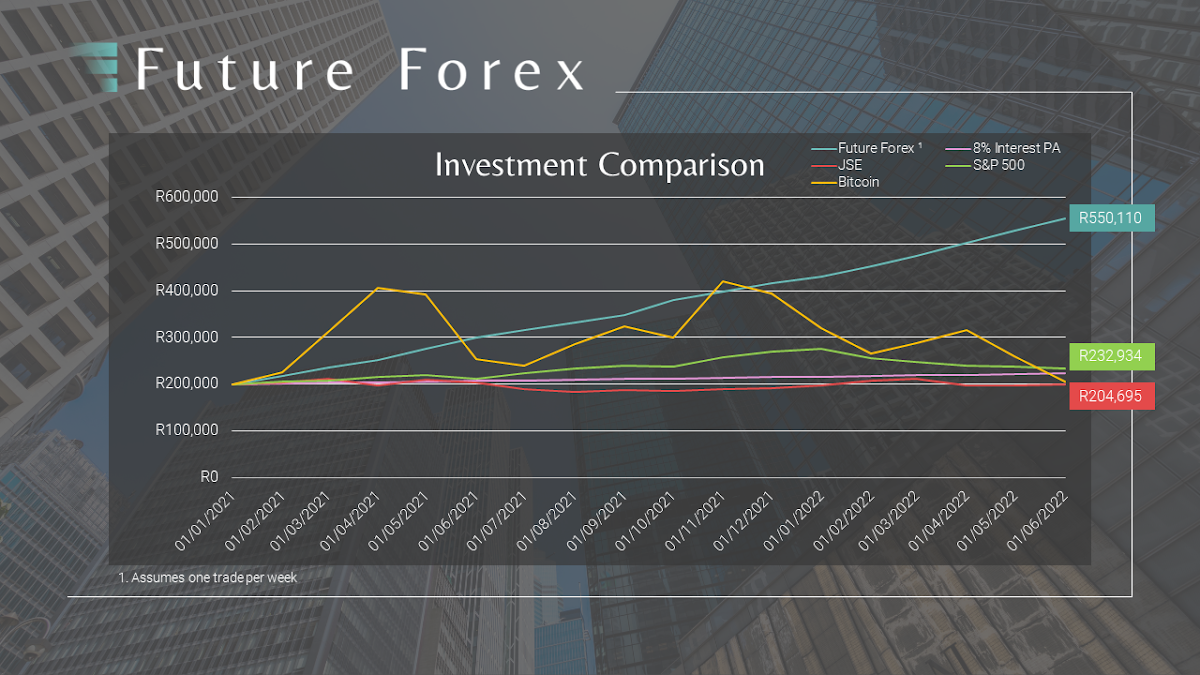
Statements detailing the spread (gross profit), third-party fees, Future Forex fees, and the net profit and balance are emailed to clients, or their advisors, after each trade. ## Who qualifies? The minimum capital required for crypto arbitrage is R100 000, though R200 000 or higher reduces some of the fixed charges (such as SWIFT fees), making it more profitable for those with more capital to trade. ## Costs Future Forex shares in the profits after third-party costs, on a sliding scale of 25-35%, depending on the investment amount. There are no other hidden fees or costs. This profit-sharing model ensures that the company’s interests are perfectly aligned with those of its clients. “If our clients don’t make money, neither do we,” says Scherzer. Register here.
For partnerships, email here for more information: partnerships@futureforex.co.za --- # What is Crypto Arbitrage – and how does it compare with other investments? Source: https://futureforex.co.za/news-and-resources/crypto-arbitrage/news/what-is-crypto-arbitrage-and-how-does-it-compare-with-other-investments Published: 2024-06-23 Unlock the potential of crypto arbitrage to boost your investment portfolio. Crypto Arbitrage capitalises on the 2%-3% premium of cryptocurrencies on local exchanges compared to overseas markets. Future Forex fully automates this process, enabling South Africans to maximise their annual offshore allowances while minimising risks. Did you know that crypto currencies, such as bitcoin (BTC), trade at a 2%-3% premium locally compared to overseas? This means that R100,000 worth of a crypto currency such as BTC bought on a US exchange will cost you between R102,000 and R103,000 to buy on SA exchanges. Savvy SA investors have been taking advantage of this discrepancy by buying crypto currencies on offshore exchanges, selling them for a higher price locally and pocketing the difference — this process is known as crypto arbitrage. ## Why crypto arbitrage opportunities exist These price differences (or arbitrage) exist because of SA's foreign exchange controls, which make global assets such as crypto currencies more expensive locally. In terms of buying crypto currencies abroad, South Africans use their foreign exchange allowance, which entitles them to direct R12m a year to offshore investments. This total is made up of a R2m single discretionary allowance and a R10m foreign investment allowance. Crypto arbitrage can help local investors take full advantage of their annual R12m foreign exchange allowance — without needing to have access to R12m of assets. Each time you invest in foreign assets, a portion of your foreign exchange allowance is used until you reach the R12m cap. The allowance is reset on January 1 each year. Crypto arbitrage can help local investors take full advantage of this allowance — without needing to have access to R12m of assets. As crypto arbitrage is cyclical process, a person with R200,000 can cycle it 60 times a year before they reach their R12m cap, for instance. It's important to note, however, that SA's foreign exchange controls also cap the profitability of crypto arbitrage to an estimated R100,000-R200,000 per person per year. Many investors use their own and their spouse's allowances to double their profits each year. ## Is crypto arbitrage new? Crypto arbitrage is a market that’s been around for many years, says Harry Scherzer, a qualified actuary and CEO of crypto arbitrage provider Future Forex. (an authorised financial services provider for currency remittance services). “While the profit potential in crypto arbitrage has been reduced over the years as more people participate in it, the price differential has been a rather consistent 2%-3% over the last year. Sometimes that gap shrinks or widens but it seems to have found an equilibrium at the 2%-3% mark. So I don’t see it disappearing any time soon.” “Crypto arbitrage has shown itself to be completely uncorrelated with the returns of a direct investment in crypto currencies like BTC, or indeed the stock market, as returns solely depend on the price difference of crypto currencies in SA compared to abroad,” says Scherzer. “Over a 24-month period, we have made some incredibly strong returns for our clients in a low-risk environment. Our average annualised return to clients exceeds 80% a year without much risk in the process. The way I see it, every South African is given an asset of having R12m to take out of the country. The vast majority allow this to expire worthless each year. Crypto arbitrage simply allows you to monetise this asset each year, while having access to only R200,000 or more.” Scherzer explains that Future Forex requires R200,000 minimum investment from clients because of the fixed costs, mainly bank charges associated with sending funds abroad, that make smaller investment amounts less feasible. “But the more you put in, the lower these costs become, and the greater the percentage profit per trade,” he says. ## How does crypto arbitrage outperform the market? Relative to other investment options available to South Africans, such as an 8% interest savings account, investing on the JSE or S&P 500, or even buying volatile BTC, crypto arbitrage provides steady market-beating returns. The graph below shows Future Forex’s crypto arbitrage returns since the first quarter of 2021, compared with other investment options. With an initial client investment of R200,000 on January 1 2021, Future Forex outperforms these options, steadily growing to R550,110 at the start of June 2022. The same investment in the JSE would have ended up flat for the same period, while an investment in the next best alternative, the S&P 500, would have grown the starting capital to R232,934, falling far short of the profit achieved by Future Forex through the crypto arbitrage. Investment Comparison Graph
The steady increase of a crypto arbitrage investment compared with the volatility of more traditional investments points to its low-risk nature. ## What are the risks? As with any investment, there are some risks with crypto arbitrage. The chief one being that either the crypto price or the currency moves sharply while the trade is under way, which can take several hours. Say the price of BTC drops before you are able to sell in SA, effectively leaving you with no profit margin. Or if the US dollar-rand exchange rate dropped while in the middle of a trade, your BTC would be worth less in rands. Fortunately, these risks are taken care of by Future Forex, which hedges the currency and crypto exposure, so any profit opportunity is locked in at the start of the trade. “A focal point for our team has been ensuring that the risk is minimised wherever possible. Our fully hedged system ensures that there are no market risks to investors as the profits are known at the outset of any trade,” says Scherzer. This ensures that Future Forex's service is price agnostic, meaning that you will still make money regardless of whether BTC doubles or halves in price while trading. One remaining risk is counterparty risk. This is a remote possibility with Future Forex, says Scherzer, given the deep due diligence performed on all its overseas and local partners. “Having eliminated the market risks entirely through our fully hedged investment system, we’ve spent a lot of time and effort selecting the best and most trusted partners for our crypto arbitrage service, to ensure that the risk of counterparty failure is low. We have performed extensive due diligence on third parties, ensuring that they are credible and reliable before engaging with them in our arbitrage process. Having performed this extensive due diligence has proved successful as we’ve never experienced a third-party failure in our tens of thousands of trades thus far.” ## What is a realistic profit expectation? The percentage gap between the buying and selling point typically fluctuates between 2%-3%. A realistic expectation is a net profit of 1%-1.5% per trade, which can accumulate to more than 100% a year, depending on the number of trades performed over the year. ## What are the costs involved? As mentioned, Future Forex requires a minimum investment of R200,000 from clients. Future Forex doesn’t take management fees. Rather, it takes a percentage of the profits earned during the arbitrage process. This profit-sharing model ensures clients’ interests are aligned with those of the company. --- # Crypto Arbitrage is going mainstream Source: https://futureforex.co.za/news-and-resources/crypto-arbitrage/news/crypto-arbitrage-is-going-mainstream Published: 2024-04-12 Crypto arbitrage is quickly becoming a mainstream investment in South Africa, offering a low-risk, high-yield opportunity that consistently outperforms traditional investments like the JSE All Share index and S&P 500. By capitalizing on price differences between local and international crypto markets, Future Forex fully automates the process for clients, mitigating market risks and delivering market-beating returns. Crypto arbitrage, once regarded as something of a cottage industry in SA, is quickly becoming a mainstream investment. It involves purchasing and selling crypto assets in different countries to benefit from the price variances in these markets. For example, bitcoin (BTC) could be sold in SA this week for as much as 3.5% more than it costs in US and European exchanges. Thousands of South Africans have woken up to this relatively low-risk opportunity to boost their portfolio returns. Future Forex, an authorised financial services provider (FSP), was one of the first crypto companies to receive its Crypto Asset Service Provider (CASP) licence from the Financial Sector Conduct Authority (FSCA) earlier this month. “This is without doubt a huge milestone for the crypto industry in SA,” says Harry Scherzer, qualified actuary and CEO of Future Forex. “This is something we have been advocating for a long time, and we are delighted that the FSCA is now licensing the crypto sector. It gives consumers the comfort that they are dealing with a regulated entity which should weed out most of the bad actors that have attached themselves to the crypto market.” “This will have a hugely positive impact on the industry, and that’s one reason why we are seeing crypto arbitrage going mainstream.” Another reason is the widening of the crypto arbitrage premium in SA, as shown in the graph below. Arb dashboard
Scherzer explains that the widening arbitrage premium (or profit) is the result of a number of structural changes in the market, the most recent being the introduction of new SA Reserve Bank (Sarb) regulations disallowing the use of loans for individuals conducting crypto arbitrage. This has reduced the volume of funds flowing through the arbitrage market, thereby increasing the profit. “In terms of new regulations, non-bank loans for individuals to use for arbitrage are no longer allowed, meaning individuals can only invest their own funds into arbitrage,” says Scherzer. “At Future Forex, we have always ensured that clients use their own funds as dictated by regulation." “We welcome the decision to disallow the use of loaned funds as this further enhances the legitimacy of crypto arbitrage, increasing the sustainability and longevity of this highly lucrative investment.” Regulations mean that South Africans have access to R12 million a year to trade. Of this, there is an annual R2 million Single Discretionary Allowance (SDA), for which no approvals are required, and an additional R10 million in the form of Approval of International Transfers (AIT). Sars approvals are required for the latter, which Future Forex handles on behalf of clients at no charge. ## Reducing risks Crypto arbitrage’s popularity stems from the fact that it is relatively low risk as it does not attempt to predict the price movement of assets. Instead, the aim is to buy a crypto asset such as bitcoin (BTC) or a US dollar stablecoin like USDC on an overseas exchange and then sell it in SA at a profit. The key risks in arbitrage trading are typically crypto price movements or changes in the ZAR/USD exchange rate while the trade is underway. However, Future Forex hedges its crypto arbitrage trades so that profits are locked in at the moment the trade is executed. In doing so, this ensures that clients aren’t exposed to any market risks. That leaves third party risks, such as the potential for failure of a third party used to complete the trade (such as a bank or a crypto exchange), but Future Forex manages this by choosing the most reputable providers after performing extensive due diligence on them, says Scherzer. Future Forex has never made a loss on a single trade in more than R23 billion processed in over 85 000 trades. ## Investment comparison The chart below compares investment returns from crypto arbitrage, the JSE All Share index, the S&P 500 and an 8% annual interest account. Crypto arbitrage offered the best returns by far, turning starting capital of R200 000 into R353 683 over 12 months. Arb dashboard ## Relationship Managers Future Forex assigns a dedicated Relationship Manager to each client to help them through the entire process, and to assist with any questions about arbitrage trading or tax. Clients also have access to an online dashboard for a real-time view of the progress on each trade, as well as the balance in the account. Arb dashboard
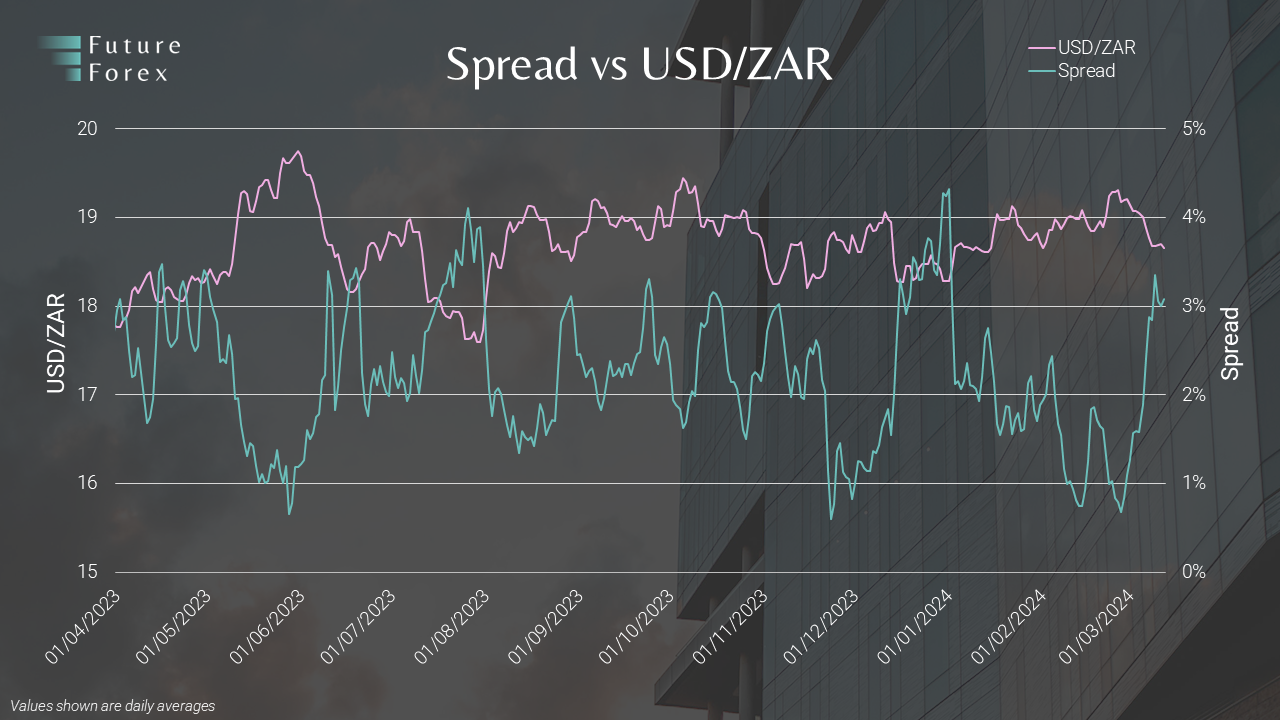
Statements are emailed to clients after each trade, detailing the spread (gross profit), third party fees, Future Forex fees, net profit, and balance. ## Who qualifies? The minimum capital required for crypto arbitrage is R200 000, although the higher the investment, the higher the returns will be. This is because certain fixed charges (such as SWIFT fees), decrease as a percentage of the total amount invested. ## Costs Future Forex shares in the profits on a sliding scale of 25-30% depending on the investment amount. There are no other hidden management fees or costs. “This profit-sharing model means clients’ interests are perfectly aligned with those of the company,” says Scherzer. “If our clients don’t make money, neither do we.” Register here. --- # Crypto arbitrage is still a great way to make passive profits Source: https://futureforex.co.za/news-and-resources/crypto-arbitrage/news/crypto-arbitrage-is-still Published: 2021-12-01 Future Forex offers South Africans a low-risk, fully hedged opportunity to earn passive profits through Crypto Arbitrage. Our client-aligned model ensures we only profit when you do, without any hidden fees. Discover how our expert team, cutting-edge technology and streamlined processes can help you maximise your annual R12 million offshore allowance. There’s no question that crypto arbitrage has become a popular way for South Africans to dip their toes into the crypto market without exposing themselves to the kind of price whiplash associated with crypto assets like Bitcoin and Ethereum. Arbitrage traders seek to profit from price differences in the same asset on different markets. For example, Bitcoin can often be purchased 2% to 3% cheaper on overseas exchanges than in SA. Future Forex is a South African company that has automated crypto arbitrage trading. All trades are fully hedged so that clients are not exposed to movements in forex or crypto prices while a trade is underway. This means profits are locked in from the moment that the trade is executed and profits are known before each trade even takes place. Annual Net Profit
The company was founded two years ago by Harry Scherzer, a registered actuary with a background in risk management, and Josh Kotlowitz, who has an MSc in space science and engineering. This unusual blend of skills has been applied to developing machine learning systems that tap the best profit-making opportunities for clients. “We’re very particular about eliminating risk and we have done everything possible to take market risk out of the equation,” says Scherzer. “Our fully hedged system is achieved by locking in the sell rate of the crypto asset at the same instant that it is bought. The risks that remain are small, such as the risk of a particular forex-dealing bank or crypto exchange failing. “Arbitrage is a well-known low-risk trading strategy." “Unlike a typical investment, arbitrage does not predict the price movement of an asset, but rather capitalises on the price differences of an asset between different markets.” ## Profit-sharing model aligns client interests with those of the company Future Forex only makes money when clients do. It shares in the profits and doesn’t charge any trading or management fees. There are no hidden fees or costs. This profit-sharing model means clients’ interests are aligned with those of the company. The minimum investment amount is R100 000. Clients can use their R2 million-a-year single discretionary allowance (SDA) and R10 million-a-year foreign investment allowance (FIA) – a total of R12 million a year. The profit share taken by Future Forex drops as clients invest more per arbitrage cycle, so those investing larger amounts per trading cycle can expect to make more profits overall. Future Forex has experts on hand to assist clients with the FIA application process at no cost. The graph below shows the progress of the bitcoin arbitrage ‘spread’ over time. It shows the price difference in Bitcoin between overseas and local exchanges, and that spread has narrowed from 4% to 5% a year ago to 2% to 3% currently. The graph also shows how the costs of trading diminish depending on the size of funds being traded. Watch the Future Forex webinar here. Clients can nominate desired profit target Annual Net Profit
“One of the advantages we can offer clients is that we allow them to nominate how much profit they want to receive net of costs,” says Kotlowitz. “Obviously, if the market is only offering a spread of 2% to 3%, a client who expects to earn 4% may only get one or two trades a year when the price gap spikes. “So we have relationship managers whose goal it is to maximise returns to each client over the year by considering their individual circumstances. They do this by assisting clients in setting a minimum targeted return, whereby trades are automatically executed if this return is attained or exceeded. “Our aim is to make the entire process as automated and passive as possible.” ## Regulation Although crypto asset providers are unregulated in SA at the moment, regulations are likely just around the corner. In anticipation of this, Future Forex has applied to the Financial Sector Conduct Authority (FSCA) to become a financial services provider (FSP), and has partnered with BeztForex, an authorised FSP, for the provision of foreign exchange conversion services. ## What crypto assets are traded? “At present we primarily trade Bitcoin and USDC, a crypto asset pegged to the US dollar, as these offer the highest returns and sufficient liquidity when compared to other crypto asset arbitrage opportunities,” says Scherzer. “We constantly monitor the market for other crypto arbitrage opportunities but at the moment the arbitrage spread in most other crypto assets is not particularly attractive for our clients. However, that may change over time, and we are always monitoring the situation.” ## Why crypto arbitrage is a relatively safe way to enter the crypto market Most investors will have heard of the astonishing returns achieved in recent years by investing in Bitcoin, Ethereum and other crypto assets. It is not unusual for these assets to show returns of several hundred percent a year, but what is also undeniable is the risk to capital that comes from investing in cryptos. For example, Bitcoin dropped 84% in 2018 after peaking at just over R300 000 in December 2017. It has since recovered and exceeded that price level, but investors had to sit through a nearly 50% drop in price earlier this year. “Cryptos are volatile, and many people are understandably nervous about investing in them given the potential for sharp drops in price,” says Kotlowitz. “This is why crypto arbitrage is a much safer and less volatile way of participating in this market. We are not taking any bets on the direction of Bitcoin; we are simply looking to benefit from price mismatches between local and overseas exchanges, and we have fine-tuned the process to the point where we have hedged out all price risks so we can lock in a profit from the moment that we execute a trade.” The crypto arbitrage market may not be around forever, says Scherzer. “Particularly once regulations come into force and large institutional investors, who are currently excluded from the market because of the lack of regulation, see an opportunity to make profits from crypto arbitrage. This could narrow the spread to virtually zero, so we may be looking at a temporary opportunity. Our advice to South Africans is to take advantage of this opportunity while it exists.” --- # Why you can never write off crypto arbitrage Source: https://futureforex.co.za/news-and-resources/crypto-arbitrage/news/why-you-can-never-write-off-crypto-arbitrage Published: 2021-02-17 As the Crypto Arbitrage landscape shifts, many might think the opportunities for profit have dwindled - but Future Forex reveals a different story. With clients reaping an impressive average return of 1.25% per trade, the potential of this unique investment opportunity remains stronger than ever.. With the exit of OVEX and VALR form the crypto arbitrage market, you could be forgiven for thinking the market is dead. Nothing is further from the truth, says Harry Scherzer, a qualified actuary and co-founder of Future Forex. “With our clients netting an average return of 1.25% per trade in January, we’re seeing more interest from the public, not less. For a lot of people unfamiliar with cryptos, this is a relatively low risk way to enter the market. There are some risks, but we’ve done everything possible to eliminate and mitigate as many of these possible.” Arbitrage involves buying an asset cheaply on one market and selling it for a profit on another. This can be done with bitcoin or any number of cryptos, such as USDC, a stablecoin backed 1:1 by the US dollar. These cryptos typically sell on SA exchanges for a higher price than they cost overseas due to exchange controls in SA. The following chart shows what has happened to the crypto arbitrage spread over time. The net profit to Future Forex clients (after costs) in the yellow line has dropped from 2-3% per trade in late 2020 to 1-1.5% per trade in early 2022 (with a trade typically taking 1-2 days). Annual Net Profit
One of the attractions of dealing through Future Forex is a fully automated arbitrage system that allows it to capitalise on the momentary spikes in the spread shown above – as often happens throughout the year. “It is typical for the arbitrage spread to shrink and widen intermittently over the course of each day, usually due to sudden spikes and dips in the rand-dollar exchange rate. “On the occasions that the spread widens, we are able to grab that profit, fully hedged for any forex or crypto price risk, and bank it for our clients,” says Scherzer. “This functionality is exclusive to Future Forex and only made possible by our strong internal systems. Not only that, we can book multiple trades per client at that momentary widening of the spread.” South Africans with tax clearance from the South African Revenue Service (Sars) have R12 million a year at their disposal for crypto arbitrage. This is broken down into a Single Discretionary Allowance (SDA) of R2 million and a Foreign Investment Allowance (FIA) of R10 million a year. The minimum required by Future Forex is R100 000. A net 1.5% a year on R12 million is R180 000 per year in potential profits. For a married couple, that R12 million becomes R24 million, and a potential profit of R250 000 or more a year. Based on the current arbitrage spread, Scherzer says most Future Forex clients are achieving a net profit target of 1-1.5% per trade, translating to an average annualised return of around 70% for clients. Market participants have worried for years that the crypto arbitrage market would disappear altogether as more people get involved. Arbitrage opportunities exist wherever the same asset is traded in different markets at different prices. The more traders spot these opportunities, the quicker these price differences disappear. Scherzer argues that the crypto arbitrage spread has narrowed over the years, but is unlikely ever to completely disappear. “There will always be shocks and misalignments between markets that will cause arbitrage spreads to widen. Our strong back-end tracking system puts us in a position to capitalise on those momentary opportunities for our clients, even if they exist for just a few minutes.” DIY arbitrage involves buying forex, shipping it to an exchange overseas (which can take several hours), buying crypto on the overseas exchange and then shipping it back for sale (hopefully) at a profit on a South African exchange. There’s plenty that can go wrong in this process: the rand exchange rate or the crypto price can move against the client while the trade is in play, reducing or wiping out any expected profit. Future Forex – which was recently awarded a financial services provider licence by the Financial Sector Conduct Authority for currency remittance services – maintains a fully hedged book which means clients are not exposed to these market risks. There is still third party risk (the chance of an exchange going bust or suffering a hack while a trade is in progress) though only the most secure exchanges are chosen as partners following extensive due diligence, says Scherzer. ## Costs Future Forex shares in the profits on a sliding scale depending on the investment amount. There are no other hidden fees or costs. This profit sharing model means clients’ interests are aligned with those of the company. ## The market demographics Josh Kotlowitz, co-founder and CTO of Future Forex, says that while the company has both male and female clients of all ages, the most common crypto arbitrage client is male, aged 40+, of high net worth and in search of savvy ways to invest their money. ## Is the crypto arbitrage market overtraded? Not by a long shot, says Kotlowitz. “We’re still waiting for the penny to drop with average South Africans, given the very contained risks of crypto arbitrage. “To date we’ve processed over R1.5 billion worth of trades and our growth, client-wise, has been tremendous. More people are talking about it, and recently our month-on-month growth has been up to 30%, and I don’t believe we’re anywhere near saturating the market.” ## Benefits of dealing through Future Forex ”Our fees are low, and we only make profits when our clients do, and that is the best guarantee that we are going to make profits for you”, says Scherzer. “We can trade at any time during the day, so when exceptional profit opportunities present themselves, we can take advantage of that. We also handle all FIA applications with Sars at no cost to the client. Each client also receives a dedicated relationship manager to walk them through the process, safely on-board them and provide a constant point of contact for any queries thereafter. Once clients are on board, the system is automatic and relatively hands-off.” Clients are also able to nominate their minimum targeted arbitrage profit level per trade, whereby their funds will only be traded if this return is matched or exceeded. Future Forex’s relationship managers assist clients in setting an appropriate minimum targeted return to maximise profits over the year. If the client wants a net 4% per trade minimum, that trade may only come around two or three times a year. A more realistic target would be 1.25% or better. “Ninety percent of our clients leave it up to us to set their minimum targeted return to a level which maximises their return over the year,” says Scherzer. ## Will regulations kill the crypto arbitrage market? Crypto regulations are on their way, and rather than driving the crypto arbitrage market out of existence, will make it harder for scammers to operate as only legitimate operators will be licenced. That may attract larger volumes of money to crypto arbitrage, particularly from institutions, but experience elsewhere in the world suggests the crypto spread may go to zero for longer periods of time, but will always reappear as risks in different parts of the world reflect in price differences between different markets. ## What cryptos does Future Forex trade? USDC, but other cryptos will soon be added to the trading list to provide more profit opportunities.